Data centers powering AI need copper wiring and transformers. EVs use nearly four times more copper than gas-powered cars. Wind turbines, solar farms and the modern electric grid all depend on it. As such, copper is a building block of tomorrow’s economy and the backbone of America’s national security.
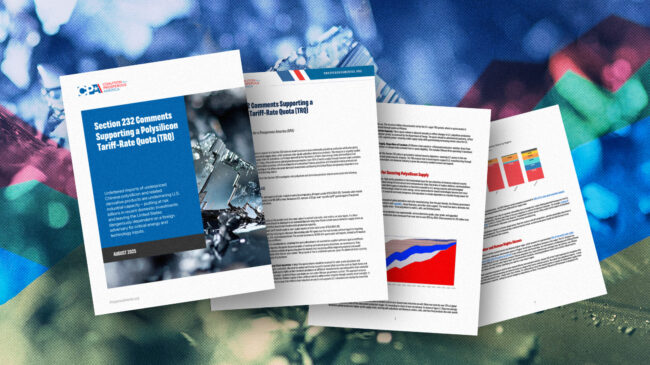
The domestic polysilicon supply remains a national security imperative for the United States for many reasons including: China’s link to forced labor and human rights abuses; a globalized Chinese Communist Party-subsidized solar industry leading to overcapacity and export dumping; and the limitations of U.S. trade remedies to help, deep into the solar supply chain.
Investigation follows formal petitions filed last month by The Alliance for American Solar Manufacturing and Trade, in response to market manipulation driven by predominantly Chinese-owned manufacturing companies operating in Indonesia, and Laos, as well as those headquartered in India.
In response to market manipulation driven by companies in Indonesia, Laos, and India, the petitions were filed by The Alliance for American Solar Manufacturing and Trade.
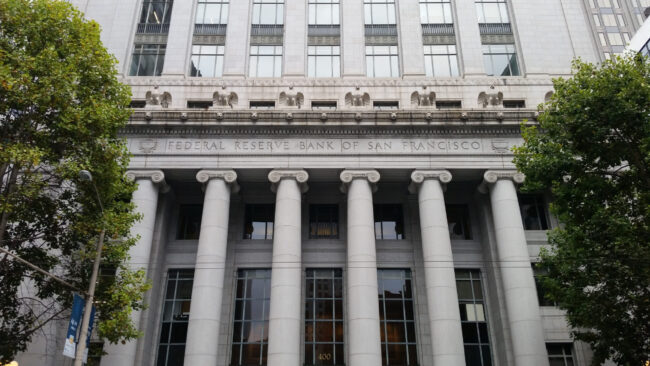
An economist with the San Francisco Federal Reserve wrote in their “Economic Letter” from July 14 that tariffs are going to lead to much higher inflation in the weeks ahead. There’s just one caveat, and senior economist Mauricio Ulate admits it up front.
For decades, U.S. politicians have sold free trade agreements as a beacon of prosperity for the American economy. The logic was tidy: “Most of the world’s consumers live outside the U.S.—so if we open foreign markets, prosperity will follow.” On paper, it sounded plausible. But in practice, it became one of the most costly economic miscalculations in our modern history.
The Senate’s decision to remove the FEOC Excise Tax and weaken FEOC restrictions is a blatant giveaway to the Chinese Communist Party’s solar industry.
Any Senator who supports an amendment to remove or weaken the FEOC Excise Tax is directly endorsing China’s solar industry—dominated by companies using slave labor, powered by coal, and compromised by severe cybersecurity risks.
CPA strongly endorses the FEOC Excise Tax in the Senate reconciliation bill as a critical step in protecting America’s solar manufacturing industry from reliance on subsidized and compromised Chinese components.