Proposals for new tariffs face a lot of criticism these days, from the media, from economists, and from foreign policy types. Part of the reason is that it’s Donald Trump making the proposals and many in those groups don’t like Trump. But the fact is that tariffs can work to build our economy. They have worked before and they have worked recently as well.
The U.S. Department of Commerce yesterday made a significant preliminary determination in its investigation into solar imports from Vietnam, Cambodia, Malaysia, and Thailand, confirming illegal trade practices through foreign subsidies.
This decision represents a significant step toward protecting American solar manufacturers and the billions of dollars in U.S. investments at risk from China’s predatory and illegal trade practices.
There is still a significant amount of work left to fully address the threats posed by the Chinese Communist Party’s (CCP) growing overcapacity in the global automotive sector, particularly through electric vehicles (EVs).
Reindustrialization might cause some above-target inflation. Deindustrialization, meanwhile, might take countries out of the running of the industries of today, and the future, too, said former European Central Bank president Mario Draghi.
The report details how China has strategically positioned itself to dominate the U.S. and global solar markets through a combination of government subsidies, overproduction, and exploitation of U.S. policy loopholes—most notably, the tax credits created by the IRA.
For years, the Solar Energy Industries Association (SEIA) has served as a de facto mouthpiece for Chinese solar manufacturers, consistently pushing policies that benefit China’s dominance in the solar industry at the expense of American manufacturers.
Commerce Secretary Gina Raimondo was asked to impose anti-dumping and countervailing duties (AD/CVD) on Southeast Asian solar companies in a letter from the United Steelworkers Union (USW) on Aug. 27.
Deployments of solar power facilities in the U.S. by utilities, commercial customers,
and residential customers have risen substantially in recent years due to
technological progress, lower costs, and various tax incentives and credits from the
U.S. government.
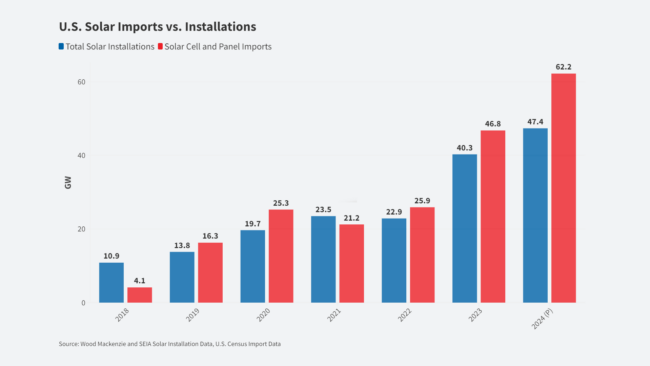
As the demand for solar energy deployment in the United States continues to grow, foreign firms are reaping nearly all the benefits. Solar imports in 2024 are outpacing total demand and crowding out domestic solar manufacturers.