Florida Congressman Daniel Webster’s ‘USA Act’, introduced in August, amends the Science portion of the ‘CHIPS & Sciences Act’ to improve U.S. role in standards setting.
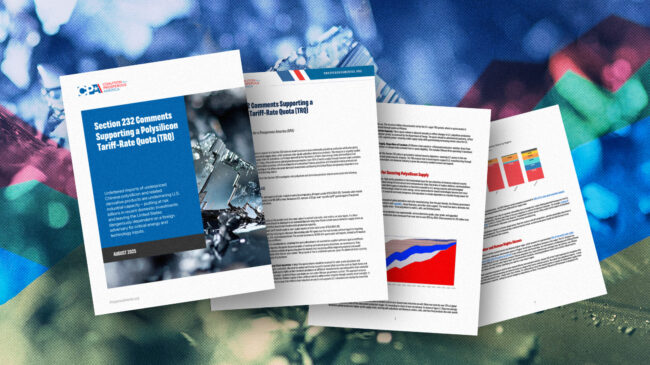
The domestic polysilicon supply remains a national security imperative for the United States for many reasons including: China’s link to forced labor and human rights abuses; a globalized Chinese Communist Party-subsidized solar industry leading to overcapacity and export dumping; and the limitations of U.S. trade remedies to help, deep into the solar supply chain.
Investigation follows formal petitions filed last month by The Alliance for American Solar Manufacturing and Trade, in response to market manipulation driven by predominantly Chinese-owned manufacturing companies operating in Indonesia, and Laos, as well as those headquartered in India.
Closing de minimis means that commercial shipments from overseas vendors must enter the United States through standard customs procedures, submit full import documentation, and pay applicable duties and taxes—a long-overdue reform to restore order and accountability to America’s trade system.
Today’s action to directly target the midstream layer—rods, pipes, wires, connectors, and other semi-finished copper products that are essential to our economy and national security is extremely welcome. Combining the Section 232 action with the use of the Defense Production Act to ensure a robust supply of copper scrap for recycling is extraordinary.
CPA submitted formal comments to the Federal Communications Commission (FCC) this week supporting its proposed rule to increase transparency regarding foreign adversary control of smart devices and appliances.
Realigning the dollar would be the most comprehensive and effective move to address the U.S. competitive disadvantage. It can be done either by a multilateral intervention agreement, or a MAC, which would be a federal tool to moderate foreign investment in dollar financial assets.
In response to market manipulation driven by companies in Indonesia, Laos, and India, the petitions were filed by The Alliance for American Solar Manufacturing and Trade.
The Senate’s decision to remove the FEOC Excise Tax and weaken FEOC restrictions is a blatant giveaway to the Chinese Communist Party’s solar industry.