To Reduce the Deficit, Tariff the Money
To reduce the deficit in a durable way, the United States must do more than tariff goods. It must tariff the money.



To reduce the deficit in a durable way, the United States must do more than tariff goods. It must tariff the money.
Section 301 is a powerful tool for addressing foreign policies that distort global markets and disadvantage American producers. When foreign governments explicitly pursue overproduction and then export the resulting surplus into the United States, the effect is to displace domestic output and deter new investment in American manufacturing.

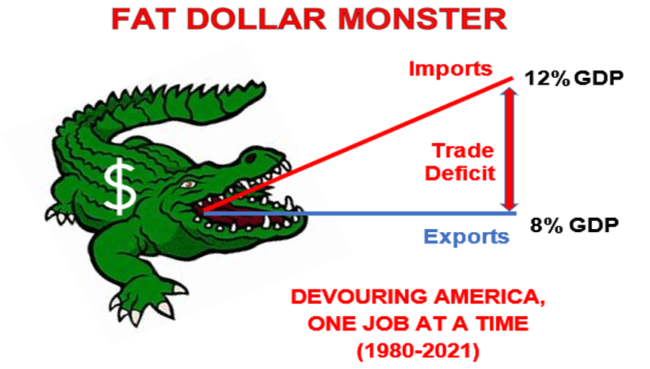
We must stop importing more goods than we export, leaving us deeply indebted to our trading partners. I urge Congress to urgently pass a bill that would implement the Market Access Charge. Call your Congressman and Senator today to urge them to support the introduction of such a bill.

Realigning the dollar would be the most comprehensive and effective move to address the U.S. competitive disadvantage. It can be done either by a multilateral intervention agreement, or a MAC, which would be a federal tool to moderate foreign investment in dollar financial assets.

A Market Access Charge (MAC) might be the perfect addition to the tariff agenda; a surgical tool to tax capital inflows.
It’s time to stop the destruction of American industry and innovation, the loss of high-paying manufacturing jobs, and the collapse of communities. We must stop importing more goods than we export, leaving us deeply indebted to our trading partners.

A look at what some senior executives are saying this earnings season about the dollar’s misalignment with the major currencies of the world.
Ex-World Banker John Hansen explains why a strong dollar might not be as good as the Washington-Wall Street consensus would have us think.

Wall Street will have to get used to a weaker dollar. If not, trillion-dollar trade deficits will be the norm. This comes at great expense to America’s industrial base, and the middle class.
President Biden is showing that he’s serious about his pledge to “Build Back Better.” His new $2.3 trillion “American Jobs Plan” offers a blueprint for