


Securing an American Aluminum Supply Chain: Why Downstream Tariff Coverage Is Essential
EXECUTIVE SUMMARY
U.S. aluminum tariff policy must consider the full aluminum value chain. Downstream extruders and fabricators account for most aluminum manufacturing employment and are the key producers converting metal into critical products used in construction, transportation, machinery, electrical systems, packaging, defense, and other industrial markets.
Primary aluminum remains strategically important, but the problem is that primary aluminum tariffs flow into downstream input costs through the U.S. country-premium. Because the United States is over 80% import reliant on primary aluminum, U.S. extruders and fabricators pay tariff-loaded prices for aluminum whether they import directly or buy domestic inputs priced against the same U.S. benchmark. When imported downstream products do not face a stronger tariff burden, U.S. producers are forced to compete against foreign finished goods made with lower-cost metal.
Downstream aluminum tariffs must be maintained, strengthened, and scaled to match or exceed that input-cost burden.
The USMCA review is the immediate test. Canada and Mexico should not receive downstream exemptions for fabricated aluminum goods. Technology-enabled rules of origin can support sanctions enforcement, but they cannot replace Section 232 tariffs designed to secure U.S. self-reliance. “North American” processing should not become a route for tariff-advantaged aluminum imports.
Rebuilding U.S. primary aluminum capacity also requires a separate power strategy. Tariffs are a necessary component to protect the market, but major smelter operators also need globally competitive long-term electricity contracts to restart curtailed capacity or justify new investment. A Presidential tariff order that could be undone at any time is insufficient. A coherent policy should protect downstream producers through stronger tariffs while supporting primary aluminum through power-backed production.
I. Aluminum Trade Policy Must Consider the Full Value Chain
The U.S. aluminum sector is a full value chain, not simply a primary smelting industry. The sector comprises of three linked aluminum segments: upstream production, secondary or recycled production, and downstream manufacturing (extruders/fabricators). Upstream production includes bauxite mining, alumina refining, and primary smelting; secondary aluminum is produced from recycled scrap; and downstream manufacturing uses primary or secondary aluminum to make the aluminum products used in motor vehicles, construction materials, consumer durables, and other critical industrial goods.
That structure matters because the tariff impact does not stop at the smelter. It flows into billet, slab, sheet, extrusions, tubes, structures, and fabricated products. A tariff system that protects primary aluminum but leaves downstream goods under-covered does not protect the full value chain. It raises aluminum input costs for U.S. manufacturers producing critical fabricated products while leaving those same downstream manufacturers without sufficient trade protection.
This phenomenon – raising tariffs on manufacturing inputs but not the manufactured outputs – is known as tariff inversion. The initial Section 232 action on aluminum suffered from this unfortunate design: applying its full tariff on primary aluminum, but omitting wide categories of fabricated aluminum products, such as aluminum structures and parts thereof, bridge-sections, towers, lattice masts, roofs, roofing frameworks, doors and windows, as well as automotive components. The negative effects were mitigated by virtue of the inconsequential ten percent tariff assigned in 2018.
Primary aluminum smelting is strategically important for the United States, but it depends on a domestic customer market. The goal is not to weaken this sector, but to make U.S. aluminum trade policy coherent across the full value chain. Because primary aluminum tariffs raise the domestic U.S. aluminum cost base through the U.S. country-premium, downstream aluminum tariffs must be scaled to match or exceed the input-cost burden faced by U.S. extruders and fabricators.
Otherwise, foreign extrusions, structures, tubes, fittings, and fabricated goods can undercut U.S. manufacturers operating with tariff-loaded input costs. Current downstream coverage is still not sufficient for domestic aluminum extruders, and import pressure remains elevated.
FIGURE 1:
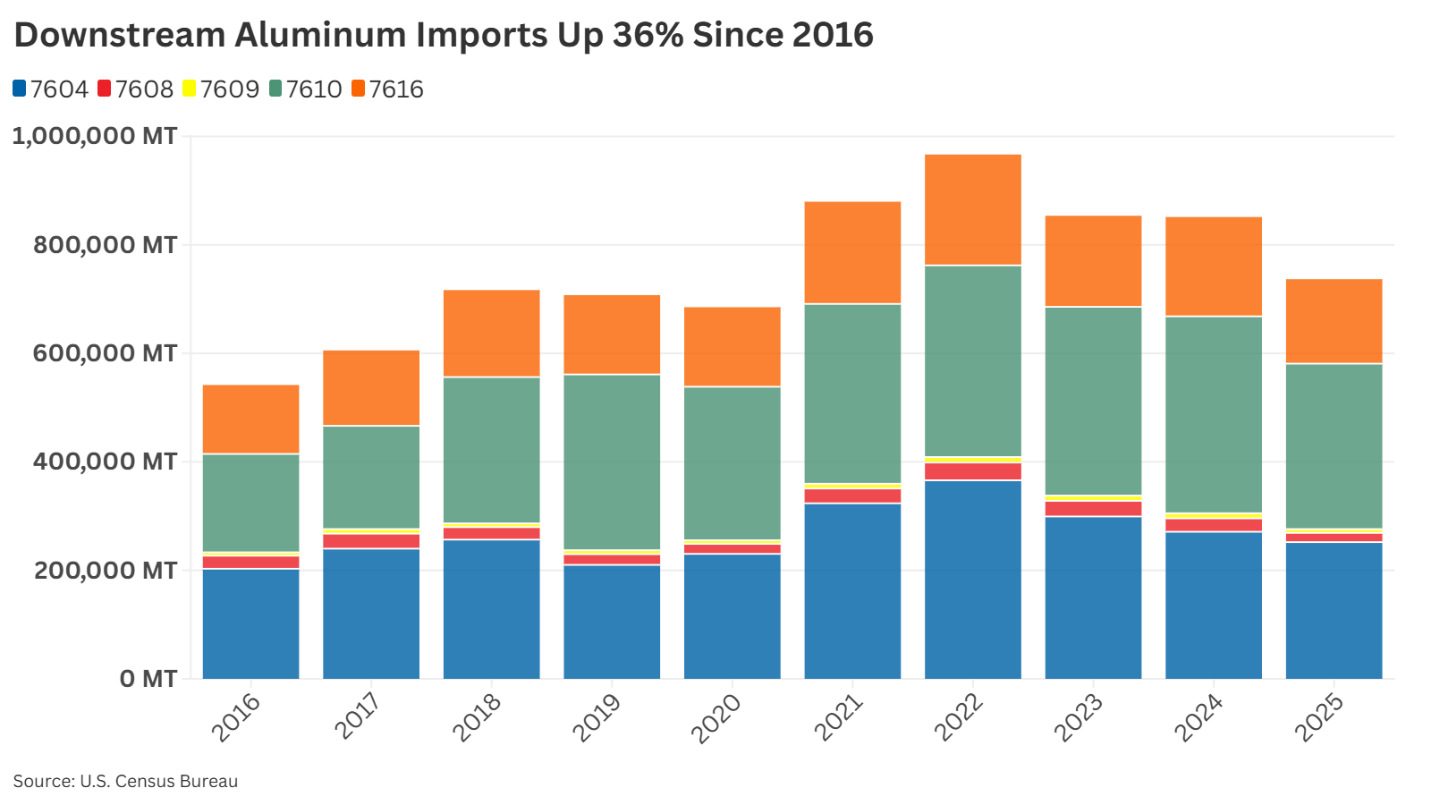
As shown in Figure 1, downstream aluminum imports under HTS 7604, 7608, 7609, 7610, and 7616 are up 36% since 2016 — just a decade ago — with the sharpest increase coming after 2020, well after Section 232 tariffs took effect [1]. These categories include aluminum profiles, tubes, fittings, structures, and fabricated articles that compete directly with U.S. extruders and downstream fabricators. Core extrusion and extrusion-adjacent categories such as 7604, 7608, and 7609 have been covered by Section 232 aluminum tariffs since 2018, while 7610 and selected 7616 products are covered through derivative and expanded Section 232 actions. The persistence of these high import levels despite existing tariffs shows why downstream coverage must be strengthened and kept exemption-proof. U.S. producers already pay tariff-loaded input prices through the U.S. country-premium; imported finished aluminum products should not be allowed to compete in the U.S. market without facing an equal or greater tariff burden.
II. The Jobs Case: Extruders and Fabricators Are the Main Aluminum Employment Base
Primary aluminum matters for supply resilience, defense needs, and high-purity applications. But most aluminum manufacturing jobs are downstream.
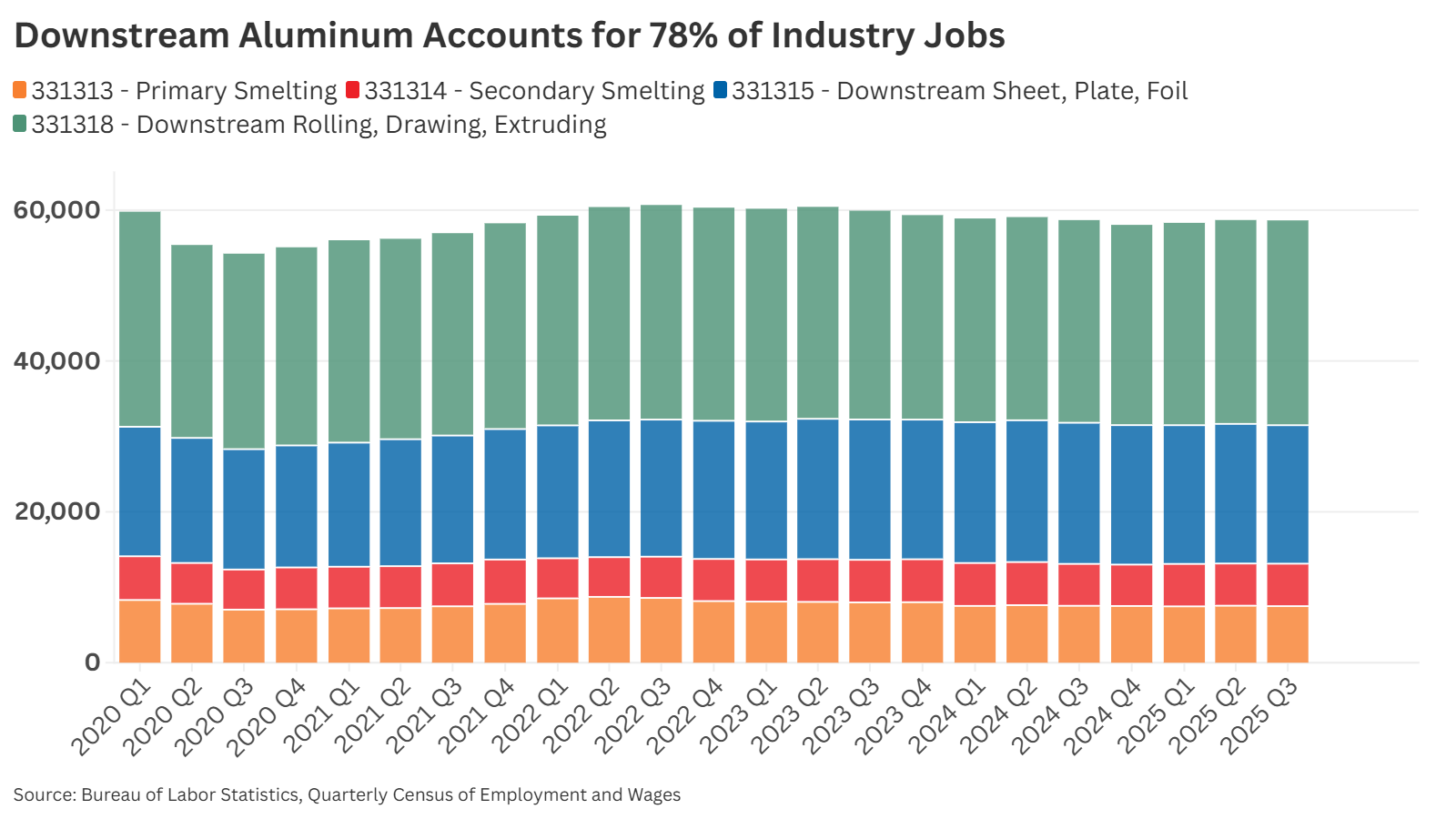
Downstream aluminum employment has consistently accounted for the dominant share of jobs across the core aluminum manufacturing categories. As shown in Figure 2, as of Q3 2025, downstream sheet, plate, and foil manufacturing, together with downstream rolling, drawing, and extruding, accounted for roughly 78% of employment across the four core aluminum NAICS categories [2], and up to 97% of employment when broader downstream fabrication categories are included. Under either measure, the employment base is overwhelmingly downstream. Primary and secondary smelting together accounted for the remaining 22%. The largest employment base is not primary smelting, but the downstream manufacturers that convert aluminum into usable industrial products.
FIGURE 2:
This is consistent with the broader industry picture. Downstream aluminum producers are also the largest segment of the U.S. aluminum industry by total value, accounting for more than 75% of the industry’s $41.3 billion in earnings in 2021 [3]. That matters because the downstream sector is where aluminum’s economic value is multiplied, in addition to the area that supports the most jobs. Primary aluminum is the essential input, but downstream manufacturers convert that metal into higher-value products used in construction, transportation, machinery, electrical systems, packaging, defense, and other industrial markets.
The broader economic impact of the aluminum industry highlights its importance to the U.S. economy. A separate industry economic-impact analysis found that the U.S. aluminum industry supports nearly 700,000 direct, indirect, and induced jobs and more than $228 billion in direct and indirect economic output [4]. These figures show that aluminum is not a narrow commodity sector. It supports a large manufacturing ecosystem, including upstream suppliers, downstream producers, transportation, construction, packaging, automotive, defense, and other related industries. Trade policy should focus on this full value chain, not only primary metal.
That employment and value structure should drive the U.S. position in the USMCA review. Downstream extruders and fabricators are not merely users of aluminum; they are the dominant source of employment and value-added activity in the aluminum supply chain. A trade policy that raises their input costs through the U.S. country-premium while allowing imported downstream products to avoid appropriately scaled duties sacrifices the sustainability of the largest segment of the industry.
III. How the Midwest Premium Passes Tariff Costs to Downstream Producers
Every significant aluminum-consuming market has a country premium embedded in aluminum procurement costs. These premiums reflect the delivered cost of making aluminum available in a national or regional market, including freight, storage, financing, insurance, local supply conditions, and tariff effects. The United States is no exception. The U.S. country-premium is commonly known in market terminology as the Midwest Premium, even though it functions as the nationwide premium for aluminum sold into the U.S. market. In this report, we refer to the Midwest Premium as the “U.S. country-premium” to make clear that the cost burden is not limited to the Midwest, and that this premium is a standard country pricing mechanism in the global aluminum industry.
When Section 232 tariffs raise the cost of primary aluminum entering the United States, that tariff pressure flows into the U.S. country-premium and raises input costs for downstream aluminum producers across the country.
U.S. aluminum is generally priced as: LME aluminum price + U.S. country-premium
The London Metal Exchange (LME) price is the global benchmark for aluminum. The U.S. country-premium is the added U.S. market premium for physically delivering aluminum to buyers in the United States. The U.S. country-premium reflects costs such as transportation, storage, insurance, financing, and other regional market factors needed to make aluminum available to U.S. buyers, including tariffs [5].
This is why the U.S. country-premium matters. When the United States raises tariffs on primary aluminum, imported aluminum becomes more expensive on a duty-paid basis. That higher replacement cost is reflected in the overall U.S. market price. The importer may pay the legal tariff, but the cost is passed through to downstream buyers through the U.S. country-premium.
As a result, downstream U.S. aluminum extruders and fabricators pay the tariff whether they import aluminum directly or buy domestic billet, slab, sheet, or other inputs. Domestic aluminum is priced against the same U.S. market benchmark, so buying domestically does not remove the tariff-loaded cost from the price.
Figure 3 illustrates this pass-through effect. The LME aluminum price rose moderately over the past year, but the sharper price change came from the U.S. country-premium after the Section 232 aluminum tariff was raised to 50%. Since June 2025, the U.S. country-premium rose more than twice as fast as the LME price, widening the gap between the global benchmark and the all-in U.S. delivered price and pushing U.S. input costs far above the base world price [6] [7].
FIGURE 3:
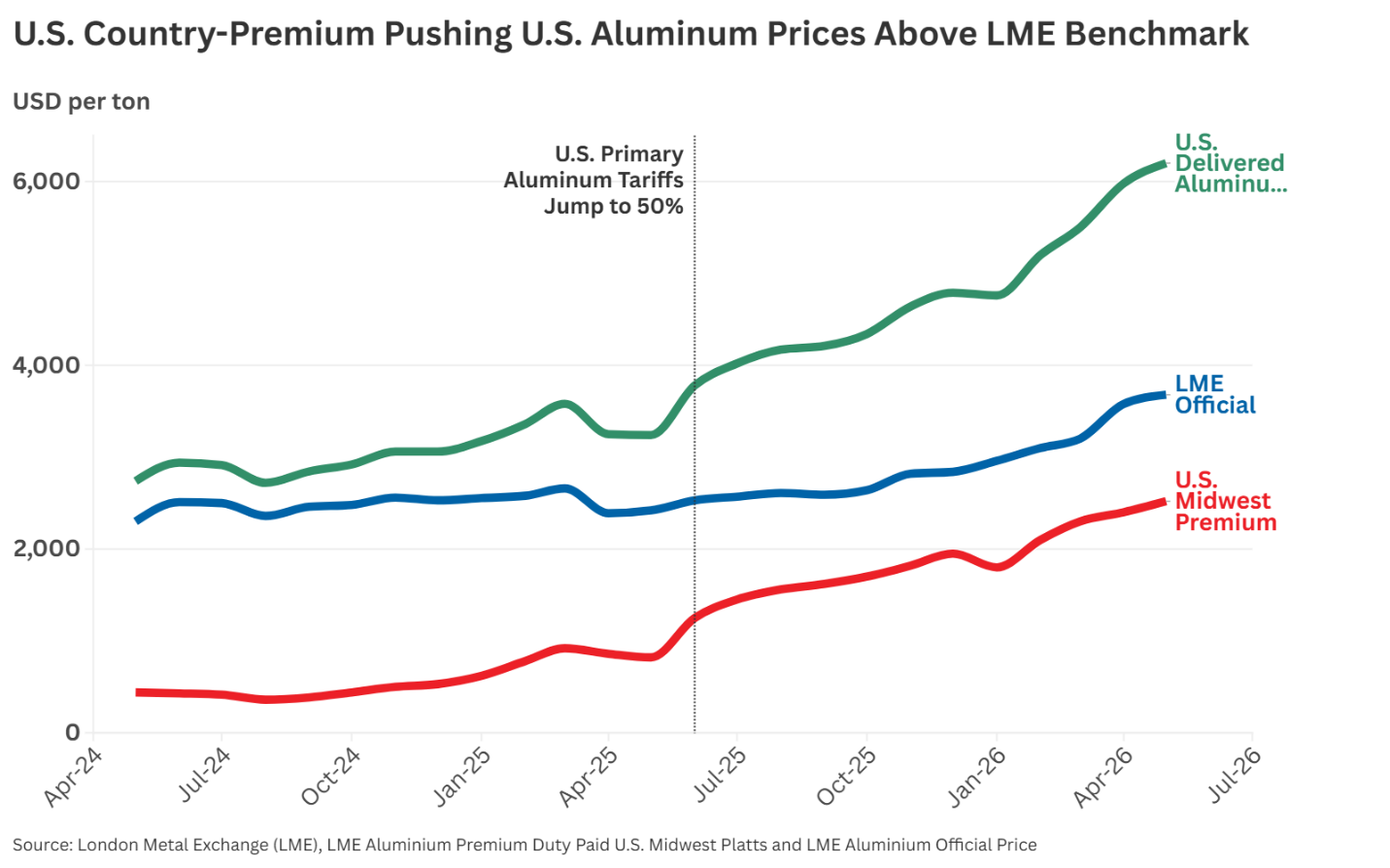
Recent market data show the scale of the burden. After the aluminum tariff was doubled to 50% in June 2025, the U.S. country-premium jumped 77% in just seven weeks [15] — and reached a then-record 88.10¢/lb, or $1,942/metric ton, in November 2025 [8]. Added to LME aluminum at $2,850/metric ton, a U.S. buyer in the spot market would pay $4,792/metric ton [8].
The climb did not stop there. The premium crossed 90¢/lb by mid-December 2025 [16] and surpassed $1.00/lb for the first time in late January 2026 [17] — all before Middle East supply disruptions added further pressure from late February. By early May 2026, the premium was trading around $2,529/metric ton, more than four times the comparable European premium, pushing U.S.-bound aluminum above $6,000/metric ton all-in [18]. The premium peaked at $2,620/metric ton, or roughly 119¢/lb, in May 2026, and was still trading near $2,374/metric ton, or roughly 108¢/lb, as of mid-July — more than 20% above the November 2025 level [6]. The U.S. country-premium alone now accounts for over 40% of the all-in transaction price of aluminum in the United States [18].
The comparison with Mexico makes the cost burden even clearer. No public premium series exists for the Mexican market, so Figure 4 uses the European duty-unpaid (Rotterdam) premium as the standard market proxy for the delivered metal cost available to Mexican and other non-tariff buyers, subject to a modest logistics adjustment. In May 2024, the gap between the U.S. country-premium and that benchmark was about $180 per ton. By May 2026, the gap had widened to about $2,000 per ton, increasing more than tenfold in just two years [18]. The result is a U.S. delivered-metal cost roughly $2,000 per ton above what Mexican extruders shipping into the U.S. market pay for their aluminum, with downstream U.S. producers carrying the difference [18].
FIGURE 4:
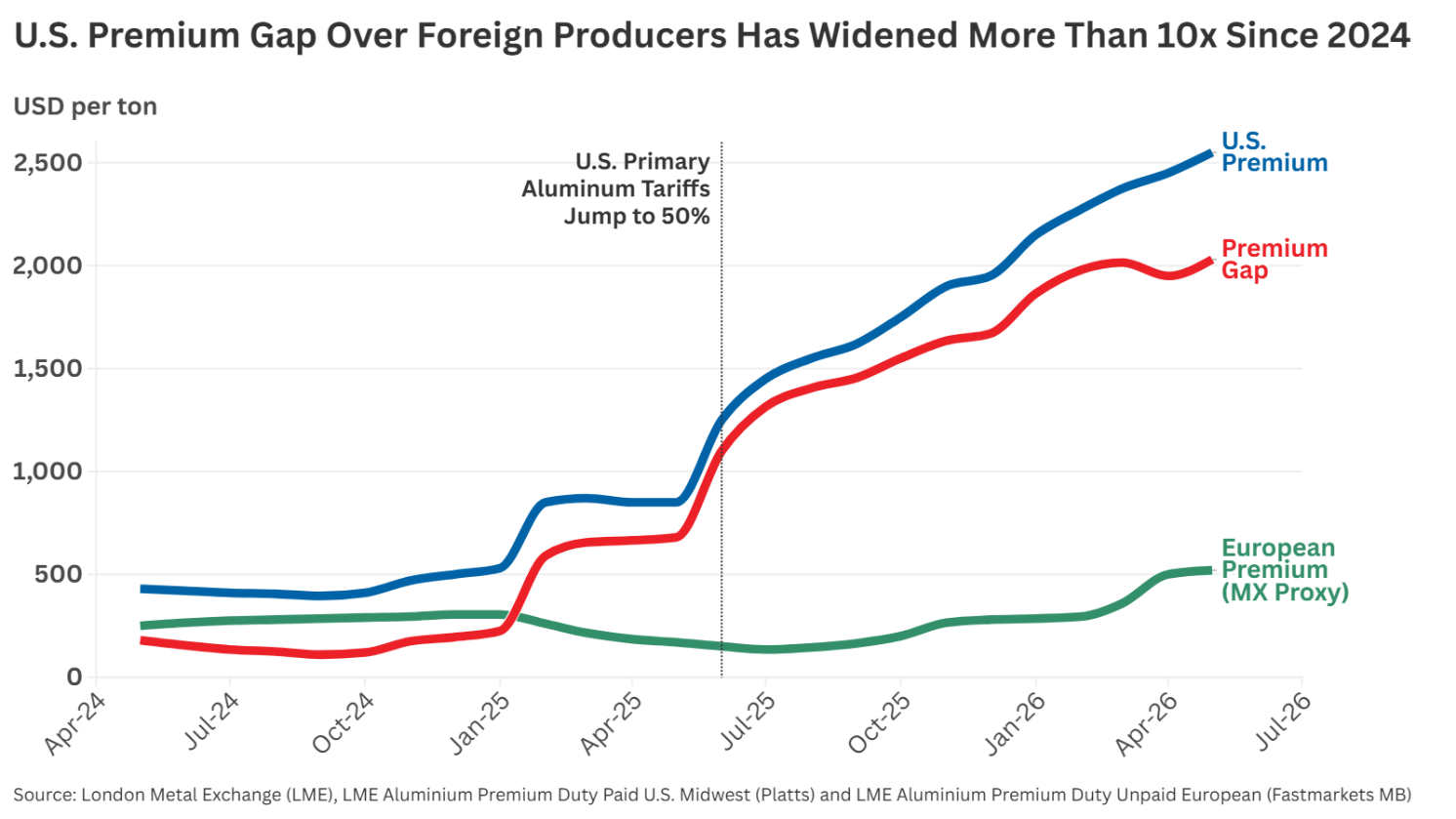
This is the core burden on extruders. Before a U.S. aluminum extruder adds labor, conversion, finishing, machining, delivery, or margin, it is already buying aluminum with the tariff embedded in the U.S. price, regardless whether they import their primary aluminum or not. If foreign-produced downstream products do not face a matching tariff burden to offset this cost pressure, the domestic producer is at a severe structural disadvantage.
IV. The Missing Link: Downstream Tariff Coverage
The missing link in aluminum trade policy is strong downstream tariff coverage. If primary aluminum tariffs are embedded into domestic input prices through the U.S. country-premium, then downstream tariffs must protect the U.S. firms that use those inputs.
Currently, domestic extruders pay the LME price plus the tariff-elevated U.S. country-premium for billet, then compete against imported extrusions that do not carry the same input-cost burden. A domestic fabricator buys higher-cost sheet, plate, tube, or profile inputs, then competes against imported finished aluminum articles made with lower-cost metal. The problem becomes even more severe if downstream products are exempt, under-covered, or routed through Canada or Mexico after limited transformation. In that scenario, the U.S. producer carries the tariff-loaded input cost while the foreign finished product avoids an equivalent cost burden.
The policy answer is straightforward: downstream tariffs must be raised, strengthened, and enforced. A primary tariff without downstream coverage raises the price of input metal while leaving the employment-heavy downstream industry exposed. A primary tariff paired with stronger downstream coverage protects the full aluminum value chain, from primary metal to finished industrial goods.
Policy has already begun moving in this direction, but it needs to be strengthened with higher rates for downstream products. The next step is to make that downstream coverage durable, stronger, and exemption-proof. Tariffs on downstream aluminum products must remain high enough to offset the U.S. country-premium burden on U.S. producers, and Canada- or Mexico-specific exemptions must not reopen the cost gap that downstream coverage was designed to close.
V. USMCA Tariff Exemptions Are Incompatible With Section 232 Recommendations
In the 2018 Section 232 Investigation of Aluminum, the Secretary of Commerce concluded that aluminum imports threatened to impair U.S. national security and recommended restrictions covering not only primary aluminum, but also downstream products, including aluminum bars, rods, and profiles under HTS 7604. Commerce recognized that the threat extended across the aluminum value chain, with foreign overcapacity, and rising import penetration. That finding is central to the USMCA review: Section 232 was designed to preserve a viable domestic aluminum industry, not merely to shift import sourcing from one foreign supplier to another. Any USMCA exemption for Canadian or Mexican downstream aluminum products would contradict the core national security finding of the aluminum investigation by preserving tariff-inflated input costs for U.S. producers while giving foreign downstream competitors privileged access to the U.S. market.
In the USMCA review, the United States must protect domestic extruders and reject any downstream exemptions for Canada or Mexico. The broader trade problem is not limited to North America. Downstream aluminum tariffs need to be raised across the board because U.S. producers face import pressure from many sources. But USMCA creates an immediate risk: exemptions for Canadian or Mexican downstream products would contradict the Section 232 remedy structure by giving foreign producers privileged access to the U.S. market while U.S. extruders continue paying tariff-inflated input costs.
The cost gap is decisive without tariff protection. With the full 50% Section 232 tariff in place, a U.S. extruder’s domestic landed cost is roughly $3.88/lb, while a Mexican extruder lands product in the U.S. at roughly $3.58/lb — still $0.30/lb cheaper even at full tariff. With an exemption from tariffs, the Mexican landed cost falls to roughly $2.39/lb, creating an unsustainable $1.49/lb, or 38%, advantage over U.S. extruders.
TABLE 1:
Cost Component (per lb) | U.S. Extruder (domestic sale) | Mexican Extruder — full 50% Sec 232 | Mexican Extruder — w/ exemption |
LME aluminum | $1.69 | $1.69 | $1.69 |
Regional premium | MWP $1.1425 + billet $0.2000 | $0.2500 (incl. billet) | $0.2500 (incl. billet) |
Extrusion conversion charge | $0.85 | $0.45 | $0.45 |
Section 232 duty on entry to U.S. | — (domestic) | $1.1950 (50% of $2.39) | $0.00 |
Landed cost in U.S. market | $3.8825 / lb | $3.5850 / lb | $2.3900 / lb |
Cost gap vs. U.S. extruder | — | $0.30/lb cheaper even at full tariff | $1.49/lb cheaper (≈38%) — U.S. industry collapses |
Per-pound landed cost of one pound of extruded aluminum into the U.S. market, using LME and Midwest Premium values as of May 12, 2026. The U.S. column reflects domestic production; the Mexican columns reflect extrusion produced in Mexico and landed in the U.S. with and without an exemption on Chapter 76 articles beyond heading 7601.
The United States still runs a surplus with Mexico in some downstream aluminum categories, including HTS 7604, which covers aluminum bars, rods, and profiles. But that surplus is weakening. It fell from 74,675 metric tons in 2016 to 53,374 metric tons in 2025, a 29% decline [1]. The remaining surplus is now at risk, and the underlying commercial position is likely already deteriorating beneath the surface. Sourcing changes begin long before they appear in trade data. Buyers often need 12 to 24 months to complete certifications, OEM print approvals, supplier qualifications, and other technical reviews before switching suppliers. If elevated U.S. country-premium prices persist, downstream buyers will have a growing incentive to shift to lower-cost foreign suppliers.
That incentive is strengthening in real time: since early May, the LME price has fallen faster than the U.S. country-premium (LME near $1.43/lb versus a premium near $1.08/lb as of mid-July 2026), so the premium now represents a larger share of the U.S. all-in cost even as global metal prices decline [6] [7]. In a falling global market, the foreign cost advantage widens rather than narrows.
That risk becomes more severe if Canada or Mexico receive USMCA exemptions. The U.S. country-premium has risen more than twice as fast as the LME price since June 2025 and now sits far above comparable foreign premiums. If the projected 38% cost gap with Mexico emerges under an exemption, the remaining U.S. surplus in HTS 7604 would quickly turn into a deficit.
Canada and Mexico pose different risks, but tariff exemptions for either country would expose U.S. manufacturers to direct displacement. As shown in Figure 5, Canada is a dominant primary aluminum supplier to the U.S. market. Meanwhile, Mexico is a downstream processing and assembly platform that converts foreign aluminum into extrusions, tubing, structures, and components for shipment into the United States.
FIGURE 5:
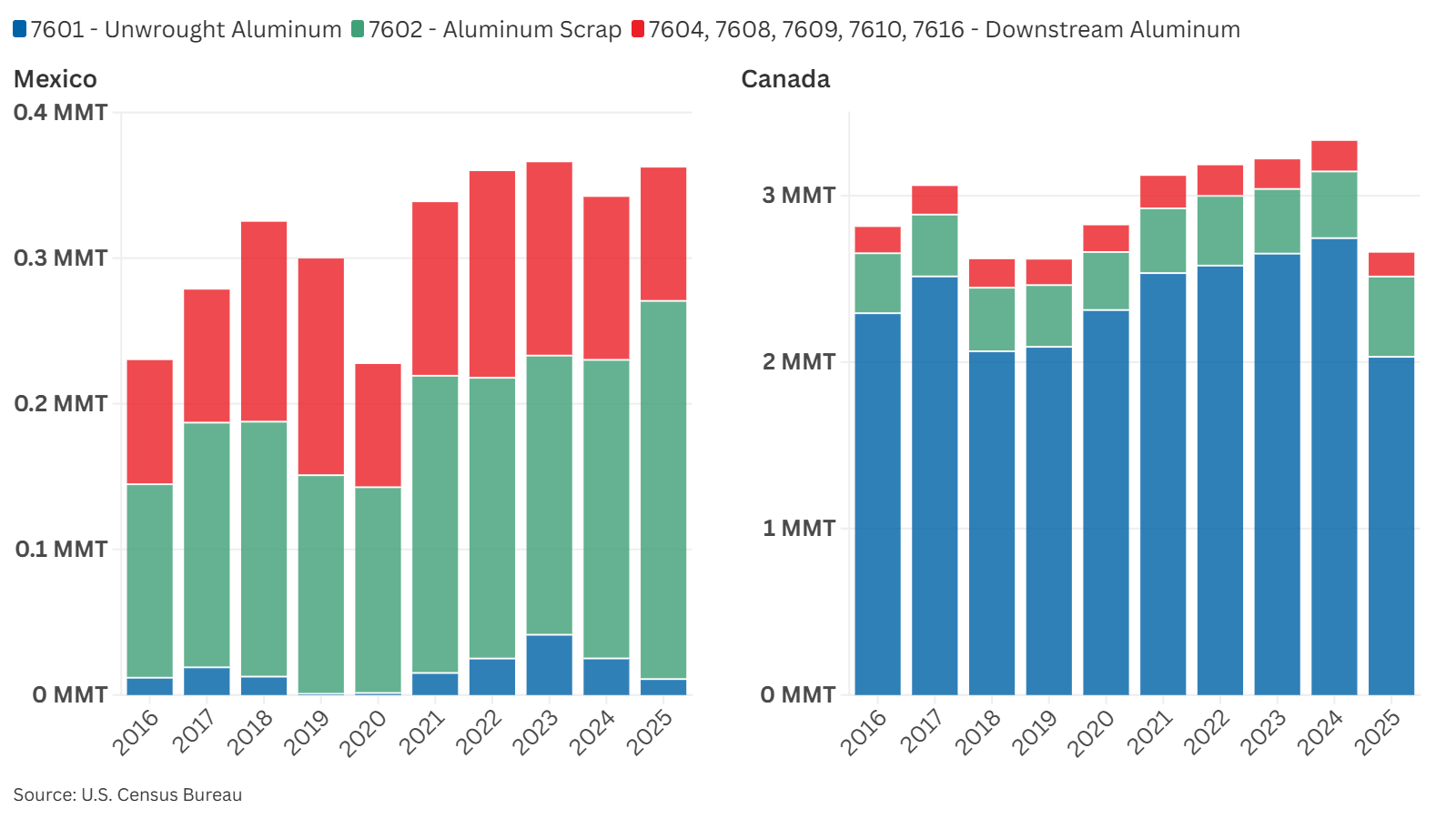
Exemptions that remove Section 232 tariffs for Canadian aluminum would not reliably lower the U.S. country-premium or relieve downstream U.S. input-cost pressure. The U.S. country-premium is not a simple weighted-average tariff charge that mechanically falls whenever one supplier receives an exemption. It is the U.S. market-clearing premium for delivered aluminum, shaped by the marginal pound needed to supply the U.S. market, replacement costs, regional availability, freight, storage, financing, and seller pricing behavior.
Because the United States remains heavily import-reliant for primary aluminum, the marginal supply needed to clear the U.S. market would still include tariff-paid aluminum from non-exempt sources. In that case, the U.S. country-premium can continue reflecting a tariff-loaded replacement cost even if Canadian producers are exempt. Exempt Canadian suppliers could then sell into the U.S. market at the prevailing tariff-loaded price without paying the tariff themselves, capturing the premium rather than eliminating it for downstream users.
The exemption experience after 2019 shows why this is not real relief. HARBOR Aluminum research for the Beer Institute found that, from March 2018 through February 2022, the U.S. beverage industry paid $1.416 billion in tariff-loaded aluminum costs, but only $111 million went to the Treasury as direct tariffs paid. The remaining $1.305 billion was captured by rolling mills and U.S. or Canadian smelters charging tariff-loaded prices [9]. That evidence directly contradicts the assumption that exempting Canada automatically lowers the U.S. country-premium for U.S. downstream manufacturers.
A Canadian exemption would therefore create a damaging policy result. It would not reliably remove the tariff-loaded input-cost burden from U.S. extruders and fabricators because the U.S. country-premium can continue reflecting the marginal tariff-paid aluminum needed to supply the U.S. market. Exempt Canadian suppliers could then sell into the United States at tariff-loaded U.S. prices without bearing the tariff themselves.
To make matters worse, a Canadian exemption would likely be sought or applied across aluminum products, not limited to unwrought primary aluminum. That would include downstream fabricated goods such as extrusions, tubing, structures, components, and other Chapter 76 articles. This would compound the injury by leaving U.S. manufacturers buying inputs at tariff-loaded U.S. prices while Canadian downstream competitors receive tariff-free access to U.S. customers.
The result would be a one-sided benefit for exempted suppliers, not a structural solution for U.S. downstream manufacturers.
VI. Rules of Origin Are Not a Substitute for Tariffs
USMCA-negotiated rules of origin are not enough to protect U.S. extruders and fabricators. Aluminum supply chains are too complex, and downstream products are too easy to transform, assemble, reclassify, and document as compliant after moving through multiple firms and countries.
That creates a side door. Foreign aluminum can enter Mexico or Canada, undergo limited processing, and return to the United States as extrusions, tubing, structures, frames, components, or assemblies. The farther downstream the product moves, the harder it becomes to verify the true origin of the aluminum content.
The enforcement record argues against relying on paper rules of origin systems. In FY2024, CBP found a 38% non-compliance rate at factories claiming preferential textile origin treatment [10], and 42% of textile shipments pulled for CBP laboratory analysis were found to be misdeclared [11]. Aluminum origin claims would face the same weakness if they rely on importer self-declarations, mill certificates, and occasional audits rather than real-time verification.
Rules of origin cannot replace tariffs. No downstream aluminum product should receive an exemption simply because it claims North American origin through a paper compliance pathway. The same principle applies to Mexican export-incentive programs such as IMMEX and PROSEC. Downstream U.S.-administered tariffs must remain the backstop.
VII. Domestic Primary Aluminum Still Matters — But It Requires Power
A downstream-focused policy does not mean abandoning primary aluminum. U.S. extruders and fabricators need reliable domestic metal supply. More U.S. primary production would reduce import dependence, improve supply security, and help ease the U.S. country-premium burden over time. But tariffs alone will not restart smelters.
The decline of U.S. primary aluminum over the past decades has been severe. The number of U.S. aluminum smelters has fallen from 33 in 1980 to only six today, with two fully curtailed and two operating below capacity [12]. Annual U.S. production has fallen to roughly 700,000 tons, and no new U.S. primary aluminum smelter has been built in 45 years [12].
The binding constraint for U.S. primary aluminum is electricity. The U.S. primary aluminum industry is operating at only 53% capacity utilization [13]. Primary aluminum smelting is extremely electricity-intensive, with power costs accounting for as much as 40% of production costs [14]. That cost structure helps explain the long-term decline of U.S. primary aluminum output: the United States is a relatively high-cost location for smelting, while major producers such as Canada, Russia, and the United Arab Emirates benefit from lower-cost power [14].
Century’s Hawesville, Kentucky smelter and Magnitude 7’s New Madrid, Missouri smelter both closed after failing to secure competitive long-term power contracts and being forced into costly day-ahead electricity markets [13].
A primary aluminum revival requires a power deal. The Hall-Héroult aluminum smelting process requires enormous electricity use, and a modern smelter needs a long-term power contract at globally competitive industrial rates. A new U.S. smelter would need at least a 20-year power contract at no more than $40/MWh to be viable [13]. Meanwhile, in the four U.S. states hosting smelters with idle capacity, electricity averaged $73.42/MWh[12].
Tariffs alone will not guarantee stable or expanding U.S. primary aluminum supply. A serious primary aluminum program must pair tariff protection with globally competitive long-term power contracts. If U.S. smelters can secure reliable electricity at viable industrial rates, existing curtailed capacity can return, new smelter investment becomes possible, and the economic benefits would reach the full aluminum value chain, including the downstream extruders and fabricators that depend on reliable domestic metal supply.
VIII. Policy Recommendations for the USMCA Review
1. Maintain and raise downstream aluminum tariffs.
The United States should maintain and strengthen tariff coverage on downstream aluminum products. Downstream tariff rates must be high enough to offset the U.S. country-premium burden carried by U.S. extruders and fabricators.
2. Reject all Canada and Mexico downstream exemptions.
USMCA should not create carveouts for any downstream Canadian or Mexican aluminum products, including extrusions, tubing, structures, components, and other fabricated aluminum goods. Exemptions would allow third-country aluminum to enter Mexico or Canada, undergo limited processing, and return to the United States as a tariff-advantaged downstream product, while U.S. firms continue buying aluminum inputs at tariff-loaded U.S. market prices.
3. Use rules of origin only as an enforcement tool, not as a substitute for tariffs.
- Rules of origin can support enforcement, but they cannot replace downstream tariff coverage. Any USMCA deal must preserve Section 232 tariffs without downstream exemptions and reject any attempt to use North American origin rules as a substitute for Section 232 tariff protection designed to strengthen U.S. production — not to create a regional preference for Canadian or Mexican downstream suppliers.
- If any aluminum ROO treatment survives, it should require real-time, on-chain verification of smelt, cast, alloy, lot, and chain of custody; paper certificates should not qualify any downstream aluminum product for reduced tariff treatment.
- Any reduced-tariff or preferential treatment for aluminum products should require lot-specific, auditable customs documentation from a U.S.-approved certifier verifying smelt, cast, billet origin, alloy, and chain of custody. Importer self-certification, generic mill certificates, or non-specific country-of-origin claims should not be sufficient. The system should ensure that USMCA treatment cannot be used for products made from non-North American billet that only undergo limited downstream processing in Canada or Mexico.
4. Pair downstream protection with a primary aluminum power strategy.
The United States should support domestic primary aluminum expansion through globally competitive long-term power contracts. More domestic primary supply would improve security and help downstream users over time, but tariffs alone will not restart smelters.
Conclusion
U.S. aluminum policy must be rebalanced around the downstream manufacturers that carry most of the industry’s employment and value. Primary aluminum remains strategically important, but extruders and fabricators are the firms that turn aluminum into construction systems, transportation parts, machinery components, electrical products, and other industrial goods. If U.S. policy raises the cost of primary aluminum, it must also strengthen and scale up downstream tariff protection.
The U.S. country-premium is the transmission mechanism that makes this tariff scaling necessary. Tariffs enacted to protect primary aluminum flow through the U.S. market and raise input costs for downstream producers, including firms that buy domestic metal. As a result, U.S. extruders and fabricators pay tariff-loaded prices whether they import aluminum directly or purchase inputs at home. If imported downstream products do not face an equal or greater tariff burden, domestic producers are placed at a structural disadvantage.
The USMCA review must not widen that gap by creating downstream aluminum exemptions. The United States should preserve and strengthen downstream aluminum tariffs, reject exemptions for Canadian or Mexican downstream products, and prevent rules of origin from becoming a substitute for Section 232 enforcement. North American processing should not become a pathway for tariff-advantaged aluminum imports.
Rebuilding U.S. primary aluminum capacity also requires more than tariffs. Smelters need globally competitive long-term power contracts, and any serious primary strategy must be tied to power-backed production. The U.S. needs to rebalance aluminum trade policy to cover the entire aluminum industry by protecting downstream manufacturers now, rebuilding primary supply through competitive power deals, and preventing regional USMCA exemptions from further undermining U.S. manufacturers and workers.
REFERENCES
[1] U.S. Census Bureau. USA Trade Online. U.S. Department of Commerce. https://usatrade.census.gov/
[2] U.S. Bureau of Labor Statistics. Quarterly Census of Employment and Wages (QCEW). U.S. Department of Labor. https://www.bls.gov/cew/
[3] U.S. Census Bureau. Annual Survey of Manufactures: Summary Statistics for Industry Groups and Industries: 2021. Table AM2231GS1. https://data.census.gov/table/ASMBENCHMARK2022.AM2231GS1
[4] The Aluminum Association. Aluminum’s Economic Impact. https://www.aluminum.org/economy
[5] S&P Global. Aluminum Midwest Premium Explained. https://www.spglobal.com/en/aluminum-midwest-premium-explained
[6] London Metal Exchange. LME Aluminium Premium Duty Paid US Midwest (Platts). https://www.lme.com/metals/non-ferrous/lme-aluminium-premiums/lme-aluminium-premium-duty-paid-us-midwest-platts
[7] London Metal Exchange. LME Aluminium. https://www.lme.com/metals/non-ferrous/lme-aluminium
[8] Desai, Pratima. “Aluminium Premium Hits Record in US on Tariffs, Global Squeeze.” Reuters, November 10, 2025. https://www.reuters.com/world/china/aluminium-premium-hits-record-us-tariffs-global-squeeze-2025-11-10/
[9] Beer Institute. “New Research Shows the Tariffs on Aluminum Have Cost the U.S. Beverage Industry $1.4 Billion.” April 14, 2022. https://www.beerinstitute.org/press-releases/new-research-shows-the-tariffs-on-aluminum-have-cost-the-u-s-beverage-industry-1-4-billion/
[10] U.S. Customs and Border Protection. FY25 Textile Production Verification Team / Priority Trade Issue Fact Sheet. February 2025. https://www.cbp.gov/sites/default/files/2025-02/FY25%20Textile%20PTI%20Factsheet%203965-0125%20%28508%29%20%282%29.pdf
[11] U.S. Customs and Border Protection. “FY 2023 Textile Enforcement Stats Show CBP’s Efforts to Protect American Jobs, Promote Economic Security.” https://www.cbp.gov/newsroom/national-media-release/fy-2023-textile-enforcement-stats-show-cbp-s-efforts-protect
[12] Home, Andy. “US Aluminium Smelters Vie with Big Tech for Scarce Power.” Reuters, May 22, 2025. https://www.reuters.com/markets/commodities/us-aluminium-smelters-vie-with-big-tech-scarce-power-andy-home-2025-05-22/
[13] The Aluminum Association and Wittsend Commodity Advisors. Powering Up American Aluminum: A Roadmap for Next Generation Supply Chain Resilience. May 2025. https://www.aluminum.org/sites/default/files/2025-05/PoweringUpAluminum_WhitePaper_2025.pdf
[14] Watson, Christopher D. U.S. Aluminum Manufacturing: Industry Trends and Sustainability. Congressional Research Service Report R47294. October 26, 2022. https://www.congress.gov/crs-product/R47294
[15] Ferguson, Colleen. “Stock Draws, Uncertain Replacement Options Push US Aluminum Premium to a Record.” S&P Global Commodity Insights (Platts), July 18, 2025. https://www.spglobal.com/energy/en/news-research/latest-news/metals/071825-stock-draws-uncertain-replacement-options-push-us-aluminum-premium-to-a-record
[16] Hellenic Shipping News Worldwide (sourcing S&P Global Platts). “Aluminum US Midwest Premium Reaches 90 Cents/lb for the First Time.” December 17, 2025. https://www.hellenicshippingnews.com/aluminum-us-midwest-premium-reaches-90-cents-lb-for-the-first-time/
[17] Packaging Dive. “High Midwest Premium, Ongoing Tariffs, Iran Conflict Hit Aluminum.” March 4, 2026. https://www.packagingdive.com/news/aluminum-steel-tinplate-tariffs-midwest-premium-2026/813711/
[18] Castano, Ivan. “With Aluminum in Short Supply, Regional Price Risks Emerge.” CME Group OpenMarkets, May 14, 2026. https://www.cmegroup.com/openmarkets/metals/2026/With-Aluminum-in-Short-Supply-Regional-Price-Risks-Emerge.html