
Cheap Imports Are Making America Poorer
Cheap imports shaved prices on some goods but never made Americans richer. Wage losses and job destruction outweighed any discounts.



Cheap imports shaved prices on some goods but never made Americans richer. Wage losses and job destruction outweighed any discounts.

For decades, U.S. politicians have sold free trade agreements as a beacon of prosperity for the American economy. The logic was tidy: “Most of the world’s consumers live outside the U.S.—so if we open foreign markets, prosperity will follow.” On paper, it sounded plausible. But in practice, it became one of the most costly economic miscalculations in our modern history.

Tariffs are a progressive policy that reverse the negative economic effects of free trade, creating good-paying jobs, boosting working-class income, and reducing income inequality.
the U.S. Private Sector Job Quality Index (JQI) was 82.99, up by +0.41% from the preceding month. Despite this slight increase in the JQI, the overall July 2024 Jobs Report from the government’s Bureau of Labor Statistics showed weak job growth.
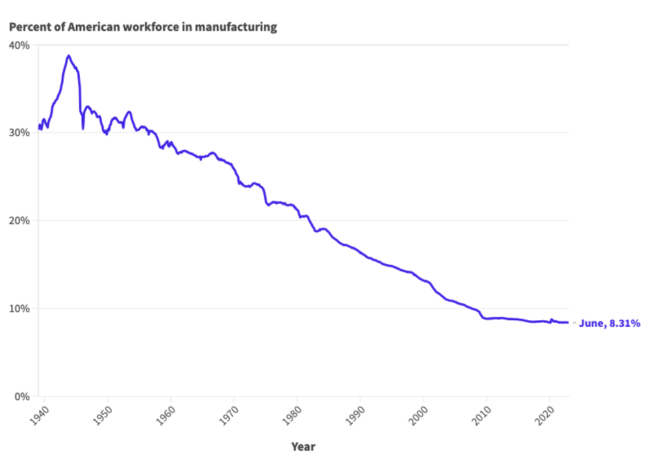
U.S. manufacturing employment hit an all-time low as a percent of the total workforce, 8.3%.

Job Quality Index shows that low-wage job growth has steadily outpaced high-wage job growth since 1990 for non-management workers.

WASHINGTON — The Coalition for a Prosperous America (CPA) today announced that the U.S. Private Sector Job Quality Index (JQI) edged up by 0.17% in February to 83.82,

A new International Trade Commission (ITC) report on the distributional effects of trade points out that import competition has negative and disproportionate effects on minority

The U.S. Private Sector Job Quality Index (JQI) rose by a slight 0.03% 81.03 in September as both low-quality and high-quality jobs rose.
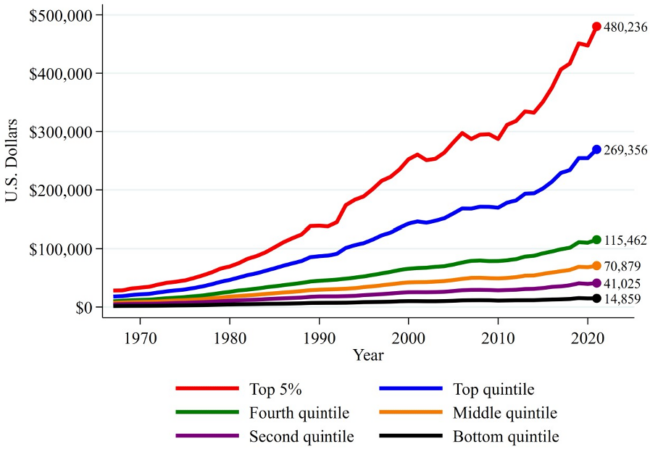
The top 5% and top 20% of U.S. households have enjoyed most of the gains in U.S. GDP since 1970. Bottom 20% have seen almost no gains in 50 years.