The findings refute claims by the pharmaceutical lobby that tariffs would harm consumers, and instead underscore the urgent need for strong trade measures to reshore U.S. production of essential medicines.
The Congressional Budget Office (CBO) upped the ante on their estimate for fiscal deficit reduction last week, all due to higher tariffs that kicked into effect this month. Tariffs are offsetting tax cuts signed into law this summer in the One Big Beautiful Bill (OBBB).
America is dangerously reliant on high-risk foreign suppliers for essential generic drugs, especially APIs concentrated in China and India. That over-reliance has already triggered preventable crises, such as nationwide chemotherapy shortages when a single overseas plant shut down.
It’s been three full months of record-high tariffs, and yet rolling 12-month overall inflation came in at 2.7% in July, the same percentage rate as June, according to last week’s Bureau of Labor Statistics (BLS) inflation report. Core inflation (CPI), which excludes food and oil, rose 3.1% in July, up from 2.9% in June.
The inclusion of these steel products in the Section 232 tariff program will mean more jobs, more Made-in-the-USA, and help provide steady-order volume to our primary steel producers.
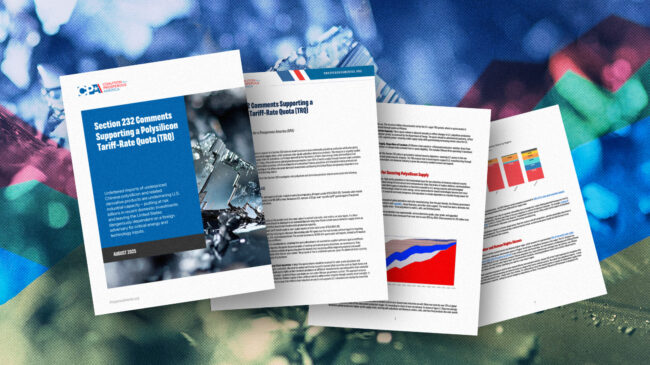
The domestic polysilicon supply remains a national security imperative for the United States for many reasons including: China’s link to forced labor and human rights abuses; a globalized Chinese Communist Party-subsidized solar industry leading to overcapacity and export dumping; and the limitations of U.S. trade remedies to help, deep into the solar supply chain.
Investigation follows formal petitions filed last month by The Alliance for American Solar Manufacturing and Trade, in response to market manipulation driven by predominantly Chinese-owned manufacturing companies operating in Indonesia, and Laos, as well as those headquartered in India.
The trade deficit fell 16% in June to a low $60.2 billion, the Bureau of Economic Analysis said on Tuesday, but despite a 3.7% reduction in imports, the goods deficit for the month was surprisingly resilient compared to recent years without tariffs.
Today’s action to directly target the midstream layer—rods, pipes, wires, connectors, and other semi-finished copper products that are essential to our economy and national security is extremely welcome. Combining the Section 232 action with the use of the Defense Production Act to ensure a robust supply of copper scrap for recycling is extraordinary.