


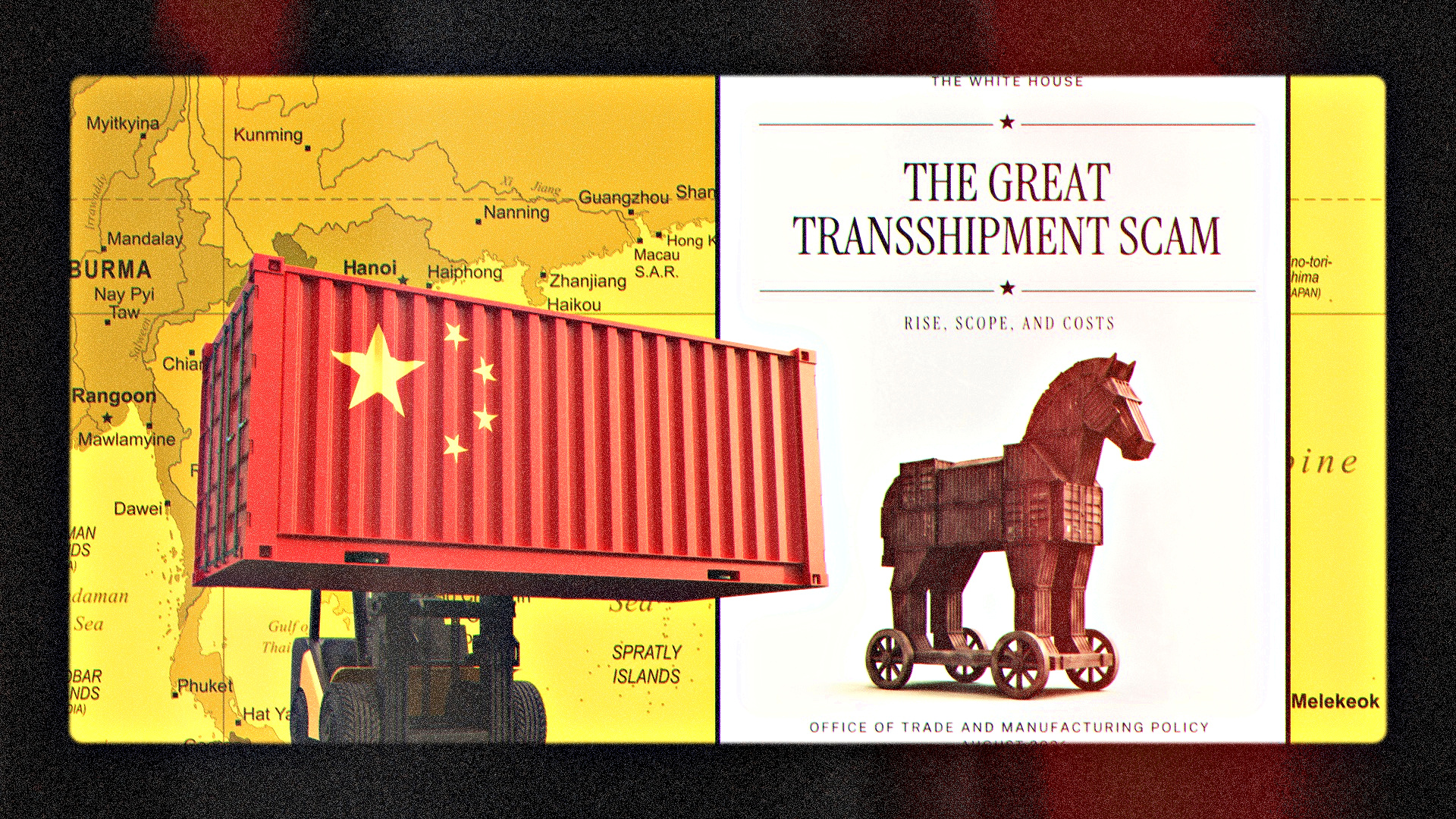
WASHINGTON, D.C. — The Coalition for a Prosperous America (CPA) congratulates the Trump Administration for drawing renewed attention to the enormous scale of transshipment and tariff circumvention through its new report, The Great Transshipment Scam. The report documents how goods subject to higher U.S. tariffs are routinely rerouted through lower-tariff countries, undermining both tariff enforcement and American manufacturing.
The Administration’s findings underscore an important principle for tariff policy: tariffs intended to reshore production should generally apply globally, with selective accommodation for imports from particular countries where warranted. When a tariff applies only to a single foreign country, policymakers should presume that affected production will migrate or transship through other foreign countries rather than return to the United States. Country-specific tariffs can serve important purposes, but they should not be confused with a comprehensive reshoring strategy.
Just as important as a tariff’s geographic scope is its form. For products where we want to protect domestic production, tariffs should be set product by product as specific duties — fixed amounts based on weight or volume — rather than as ad valorem percentages of declared value. An ad valorem tariff invites the second great scheme alongside transshipment: undervaluation. Because the foreign exporter controls the invoice, a percentage-based duty can be hollowed out simply by understating the price — no rerouting required. A specific duty cannot be undervalued away. A tariff set as a fixed dollar amount by weight or volume collects the same revenue and provides the same protection whether the customs paperwork declares the shipment at full value or at a fraction of it, and it gives CBP an objective, physical basis — weight and volume — for enforcement.
The Administration has already recognized this in practice. Its recent Section 232 polysilicon proclamation set duties by reference to minimum import prices across the solar supply chain — so that the duty owed is anchored to a price floor per unit of product, not to whatever value the exporter chooses to declare. That structure, which CPA supported in its formal comments to the Department of Commerce, is a template: it makes undervaluation pointless and gives domestic producers protection that cannot be eroded by creative invoicing. The same product-by-product, quantity-based approach should become the default across America’s tariff architecture.
“Transshipment and undervaluation are two sides of the same scam — one changes the country on the paperwork, the other changes the price,” said Jon Toomey, President of CPA. “The answer to both is tariff architecture that leaves nothing to the honor system: global coverage so there is no low-tariff country to route through, and specific, per-unit duties so there is no invoice to fake. The Administration’s polysilicon proclamation proves it already knows how to build tariffs this way. Now it should make that the rule, not the exception.”
The Administration’s report validates what American manufacturers have been documenting on the ground for years. Members of the Industry Alliance for Trade EnforcementNOW (TEN), the cross-industry alliance of U.S. businesses launched last fall to spotlight trade fraud and demand enforcement outcomes, have collectively invested years and tens of millions of dollars fighting circumvention through every tool the system offers — Enforce and Protect Act (EAPA) petitions, False Claims Act cases, and CBP e-Allegations. Their experience is sobering: even when members proved evasion in every EAPA case they filed, the illegal activity often continued under new corporate names with few consequences for the evaders. TEN’s practitioner-driven enforcement priorities — including a public enforcement scorecard tracking cases, outcomes, and duties actually collected — are exactly the accountability the Administration’s report now demands.
For products where the United States maintains meaningful domestic production but remains partly dependent on imports, CPA has endorsed an approach modeled on America’s successful sugar program. Under this model, domestic producers receive certainty about the share of the U.S. market available to imports, while necessary imports are concentrated among a limited number of approved foreign suppliers. Those countries, in turn, have a strong economic incentive to prevent third-country producers from transshipping through them and consuming their valuable U.S. market allocation.
CPA has proposed such an approach for generic pharmaceuticals, combining strong protection for American production with carefully managed access for trusted foreign suppliers. Read more in CPA’s analysis, To Reshore Generic Drugs, Use Sugar’s Sweet Model.
The Administration is right to recognize transshipment as a systemic problem — and it has already taken important steps, including the customs enforcement executive order cracking down on non-resident importers and undervaluation that CPA applauded in June. The next step is ensuring that U.S. tariff architecture is designed not merely to change the country listed on an import declaration, but to move production back to the United States — global in scope, specific in form, and rigorously enforced.
# # #