


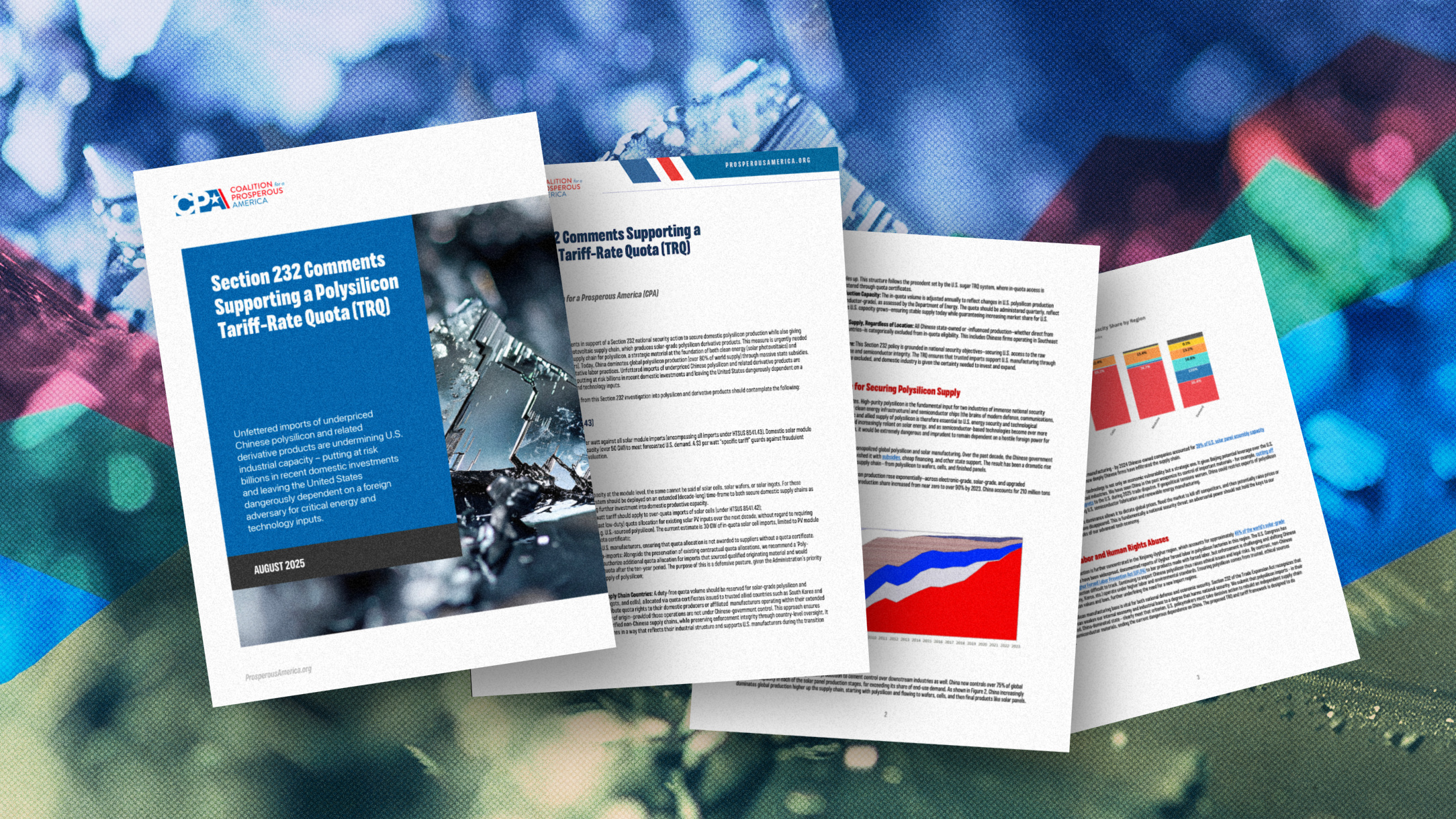
WASHINGTON, D.C. — The Coalition for a Prosperous America (CPA) submitted formal comments to the Bureau of Industry and Security (BIS) at the Department of Commerce supporting a Polysilicon Tariff-Rate Quota (TRQ).
TRQ’s are tariffs that kick in after a specified volume has been imported without the tariff, often at near duty-free rates. Managing these imports is an important part of reshoring the full supply chain for solar, America’s fastest growing source of electricity.
The domestic polysilicon supply remains a national security imperative for the United States for many reasons including: China’s link to forced labor and human rights abuses; a globalized Chinese Communist Party-subsidized solar industry leading to overcapacity and export dumping; and the limitations of U.S. trade remedies to help the industry deeper into the supply chain.
CPA’s comments were submitted as part of a Section 232 national security investigation. CPA argues that action is needed to secure domestic polysilicon production while giving tailored import relief for the solar-photovoltaic supply chain.
“America’s adversaries continue to embed themselves into the digital, energy, and advanced manufacturing infrastructure of American connected devices, which is a direct threat to our economic and national security,” said Jon Toomey, President of CPA. “This 232 investigation is a vital first step toward ensuring America takes back control over its domestic polysilicon and derivative products production, while providing relief to the solar manufacturing supply chain, and ridding the U.S. of its dangerous dependence on foreign nations seeking to control our critical energy and technology inputs.”
From CPA's comments:
Between 2004 and 2023, China’s share of global polysilicon production rose exponentially—across electronic-grade, solar-grade, and upgraded metallurgical-grade. China’s global production share increased from near zero to over 90% by 2023. China now accounts for 210 million tons of the global 225.6 million tons of polysilicon production.
CPA filing urges the BIS to:
- Impose high universal tariffs on finished solar panels.
- Establish a flexible TRQ for upstream inputs, calibrated to annual U.S. production capacity and limited to in-quota trusted suppliers.
- Cover both solar- and semiconductor-grade polysilicon, as well as all key downstream solar inputs (ingots, wafers, and cells) and finished modules.
- Exclude Chinese-controlled entities and transshipped goods.
There are a number of reasons why acting right now on a Section 232 investigation is essential. Despite multiple tariffs—AD/CVD, Section 201, and Section 301—U.S. solar trade policy remains fragmented, reactive, and porous. Narrow product scopes, country-based targeting, and enforcement delays have allowed Chinese firms to dominate U.S. solar imports via Southeast Asia, even after being found guilty of circumvention.
A TRQ can restore a secure, enforceable, and U.S.-aligned solar supply chain that gives domestic investors more predictive power as to how much product will flow into the U.S. Unfettered imports of Chinese polysilicon and solar products are undermining U.S. investment in new solar that were made under the Inflation Reduction Act during the Biden administration, as CPA’s chief economist noted in a report last year.
CPA supports the administration’s investigation and advises it to act swiftly on the TRQ framework under Section 232 for this early ingredient required to make solar cells.
# # #