


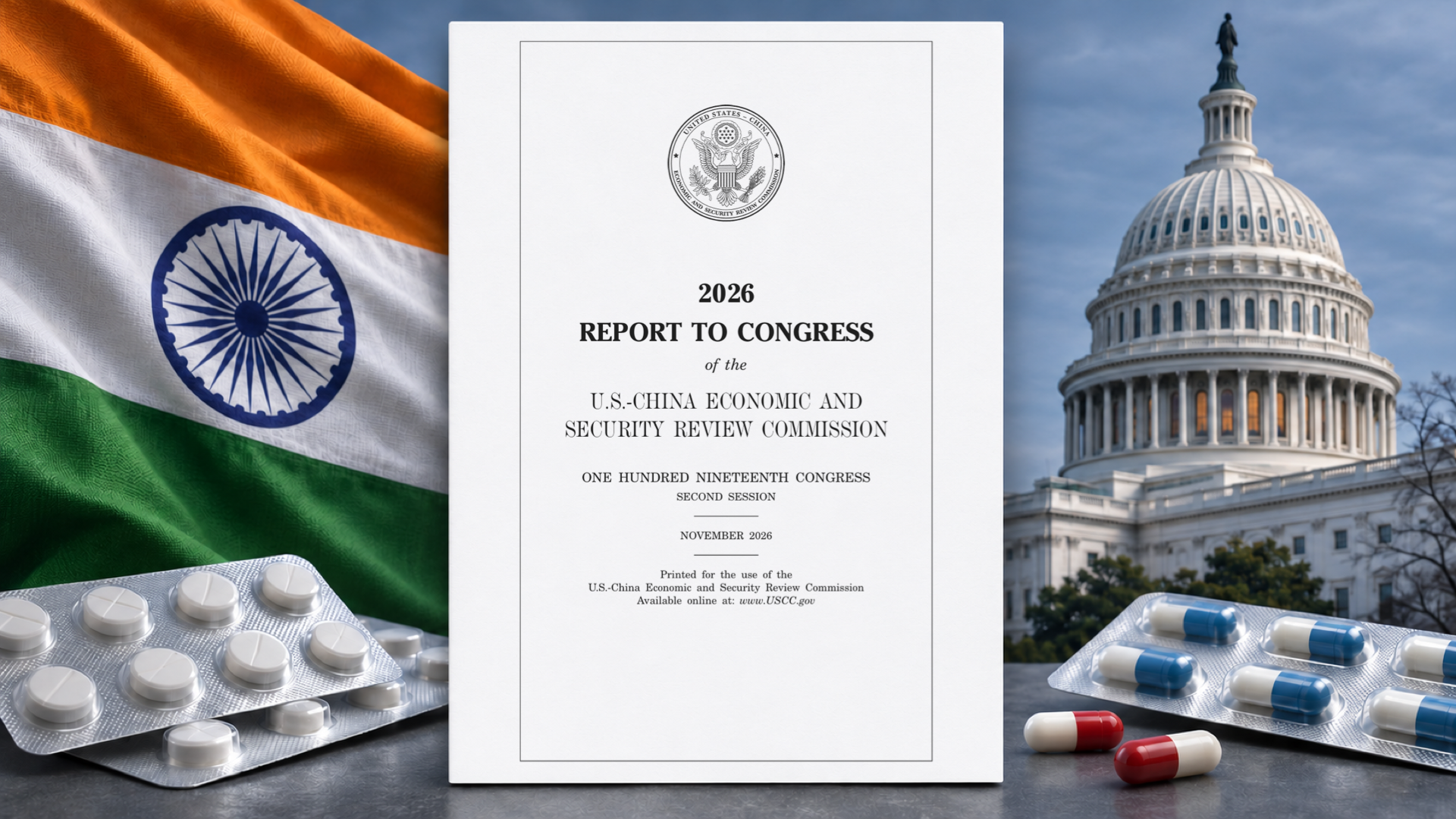
Federally mandated China Commission met with pharmaceutical industry representatives in India before recommending investment in Indian drug ingredients; CPA urges Congress to examine the full supply chain along with existing non-Chinese production.
WASHINGTON, D.C. — The Coalition for a Prosperous America (CPA) today questioned a U.S.-China Economic and Security Review Commission (USCC) recommendation that Congress support investment in India’s pharmaceutical manufacturing. CPA’s concerns are based on extensive U.S. Food and Drug Administration (FDA) and World Health Organization (WHO) findings regarding problems with Indian-made medicines as well as concerns regarding India’s dependence on chemical inputs from China.
CPA is calling for disclosure of the pharmaceutical industry representatives who met with the Commission during a March 2026 visit to India before the recommendation is considered.
On March 10, the U.S.-India Strategic Partnership Forum hosted a USCC delegation led by Vice Chair Michael Kuiken in New Delhi. The Forum reported that the commissioners met with senior representatives from several industries, including pharmaceuticals; its public account did not identify the pharmaceutical industry participants. The Commission’s subsequent annual report proposed a Comprehensive Critical Drug Diversification program with multi-year federal purchasing commitments and an initiative to support public and private investment in India’s production of active pharmaceutical ingredients (APIs) as well as key starting materials.
“The Commission has every reason to consult industry. But Congress is entitled to know which companies were heard, what evidence was presented, and whether the Commission thoroughly examined the manufacturers and supply chains it now proposes to support,” said Jon Toomey, CEO and President of CPA. “A recommendation of this consequence should rest on thorough investigation of pharmaceutical quality, upstream sourcing, and existing industrial capacity—not simply the appeal of a different foreign manufacturing location.”
Such considerations are particularly relevant for the antibiotics industry. In an April 2026 study, CPA Senior Economist Andrew Rechenberg found that China supplied 91.3% of India’s imported antibiotic APIs by volume from January 2024 through December 2025. China also accounted for approximately 87% of U.S. antibiotic API imports by volume, and roughly 90% of global capacity to manufacture 6-aminopenicillanic acid (6-APA)—the essential intermediate input used to make amoxicillin and other penicillin-class antibiotics.
In contrast, the United States has no industrial-scale producer of 6-APA or penicillin-class APIs, according to Rechenberg’s study. The only remaining, fully vertical production site in Europe is Sandoz’s Kundl facility in Austria; the company identifies it as Europe’s only fully integrated penicillin operation capable of fermenting 6-APA. That means Kundl provides one of the few remaining established sources of penicillin ingredients outside of China’s dominant production base.
Kundl’s continued operation cannot be taken for granted. In written testimony to the UK Parliament, Sandoz warned that India’s penicillin manufacturing remains heavily dependent on Chinese pharmaceutical intermediates. This is the same, state-supported Chinese production that also threatens the economic viability of Kundl as Europe’s remaining antibiotic manufacturer. Sandoz also reported that India is using minimum import prices to protect its own penicillin industry against low-cost Chinese imports. That could potentially increase pressure on Kundl as one of the West’s last major, vertically integrated penicillin manufacturing operations.
“If the objective is to reduce China’s leverage over essential antibiotics, the strategy must begin with the actual production of fermentation inputs, intermediates, and APIs,” Toomey said. “There is no industrial-scale 6-APA production in the United States, and one of the last major non-Chinese sources is operating in Austria under intense price pressure. A serious assessment should explain how federal policy can preserve and expand independent capacity—including rebuilding it here at home—before recommending that the United States deepen its investment in India.”
The Commission’s recommendation recognizes China-related sourcing risks. It also proposes verification, and a declining reliance on Chinese inputs, as conditions for participating manufacturers. Such safeguards, however, do not by themselves establish that new Indian capacity can become commercially sustainable without Chinese inputs, or that the United States would gain a genuinely independent source of supply.
Quality oversight issues also raise concern. The WHO has issued repeated medical product alerts involving medicines manufactured in India. In 2022, it reported toxic contamination in four pediatric syrup products made by Maiden Pharmaceuticals including fatalities in The Gambia. In October 2025, the WHO issued another alert concerning three contaminated oral liquid medicines in India. Indian authorities advised the WHO that the 2025 products had not been exported.
Similarly, the FDA’s findings extend across the industry. At Cipla’s Pithampur facility, an FDA warning letter described approximately 3,000 complaints involving albuterol rescue inhalers from April 2020 through December 2022. Most alleged that the devices would not spray or appeared empty or underfilled. The FDA subsequently confirmed these defects in the medication’s delivery, criticized the company’s investigations, and acknowledged that Cipla conducted a Class I recall for six defective batches. Cipla reported no adverse events associated with the recall. The warning letter to Cipla also cited contamination of sterile-manufacturing simulations as well as inadequate investigation of the various incidents.
At Intas Pharmaceuticals, FDA investigators documented destruction of original laboratory records. In July 2026, the FDA cited Dabur India for falsified manufacturing records and other serious quality-system deficiencies. In November 2026, the FDA warned USV Private Limited about deficiencies in aseptic processing and sterility controls. Separately, contaminated artificial tears manufactured in India were associated with a U.S. outbreak involving 81 patients including 14 reports of vision loss.
These findings cover specific facilities and products; they do not establish that every Indian manufacturer is non-compliant. They do, however, demonstrate a recurring regulatory record that must be addressed prior to any recommendation involving public support for Indian drug production. The FDA’s FY2024 pharmaceutical quality report found that approximately 13% of Indian sites with classified inspection histories warranted official action compared to 8% of U.S. sites and 2% of European sites. These are inspection classifications, not rates of defective drugs.
“The FDA, EMA, and WHO have produced extensive records,” Toomey said. “The China Commission should have tested its recommendation against their various findings. Without such investigation, it makes little sense to prioritize a country with well-documented regulatory concerns, a history of pharmaceutical export restrictions, and substantial dependence on Chinese inputs. Not doing so raises serious questions about the rigor of the Commission’s report.”
Moving forward, CPA urges Congress to obtain the Commission’s relevant meeting records and analyses. Lawmakers should also evaluate the FDA and WHO findings, determine the true country of origin for critical pharmaceutical inputs, and consider the effect of any new investment program on existing, non-Chinese antibiotic production.
CPA advocates for long-term purchasing commitments, targeted trade measures, and investment incentives that can rebuild domestic fermentation, API production, and finished-dose capacity while preserving verifiable, independent sources of essential inputs.
# # #