


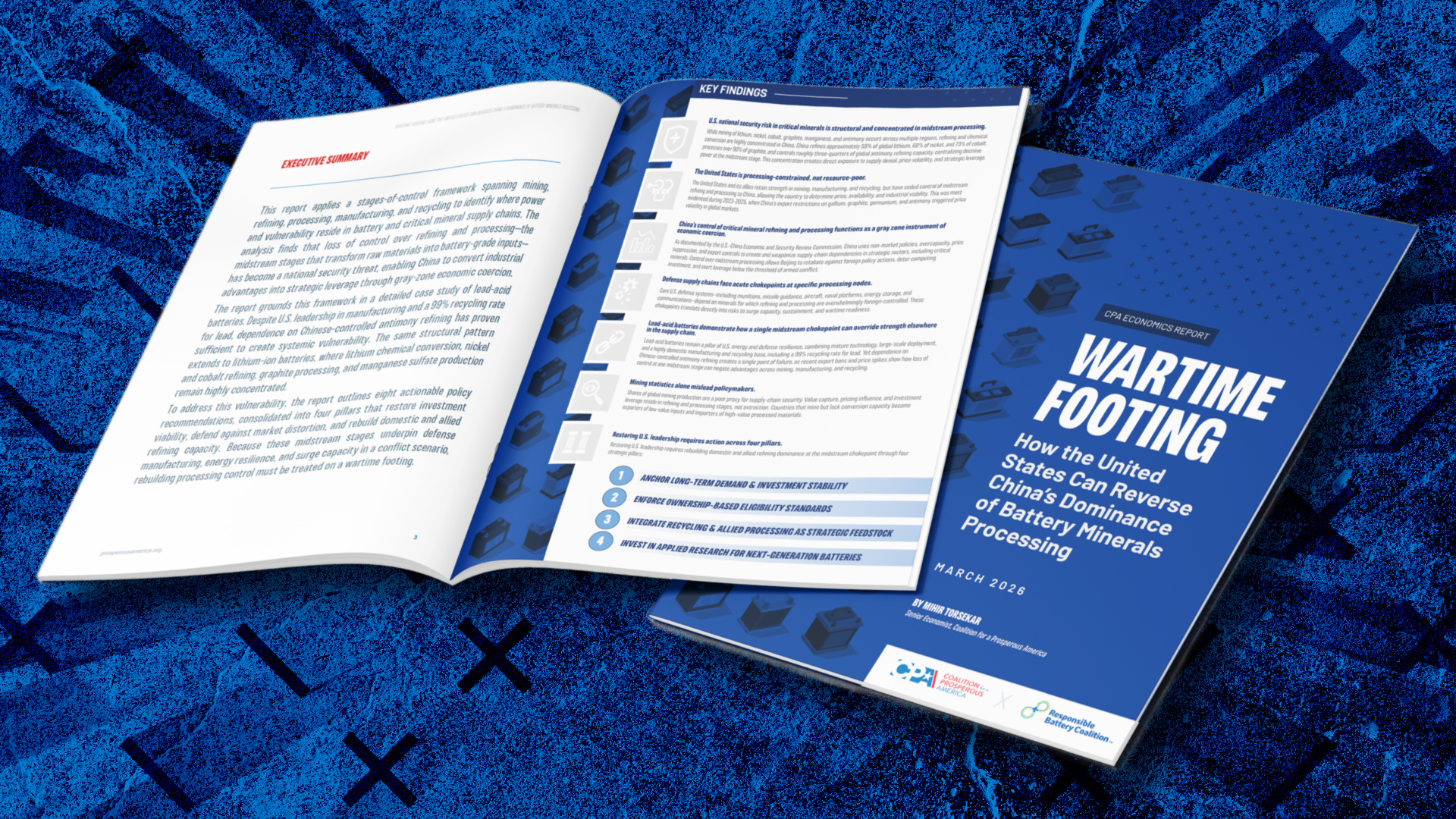
WASHINGTON, D.C. — The Coalition for a Prosperous America (CPA) and the Responsible Battery Coalition (RBC) today released a new report, “Wartime Footing: How the United States Can Reverse China’s Dominance of Battery Minerals Processing,” warning that U.S. national security vulnerabilities in critical minerals stem not from resource scarcity but from China’s control of refining and chemical processing.
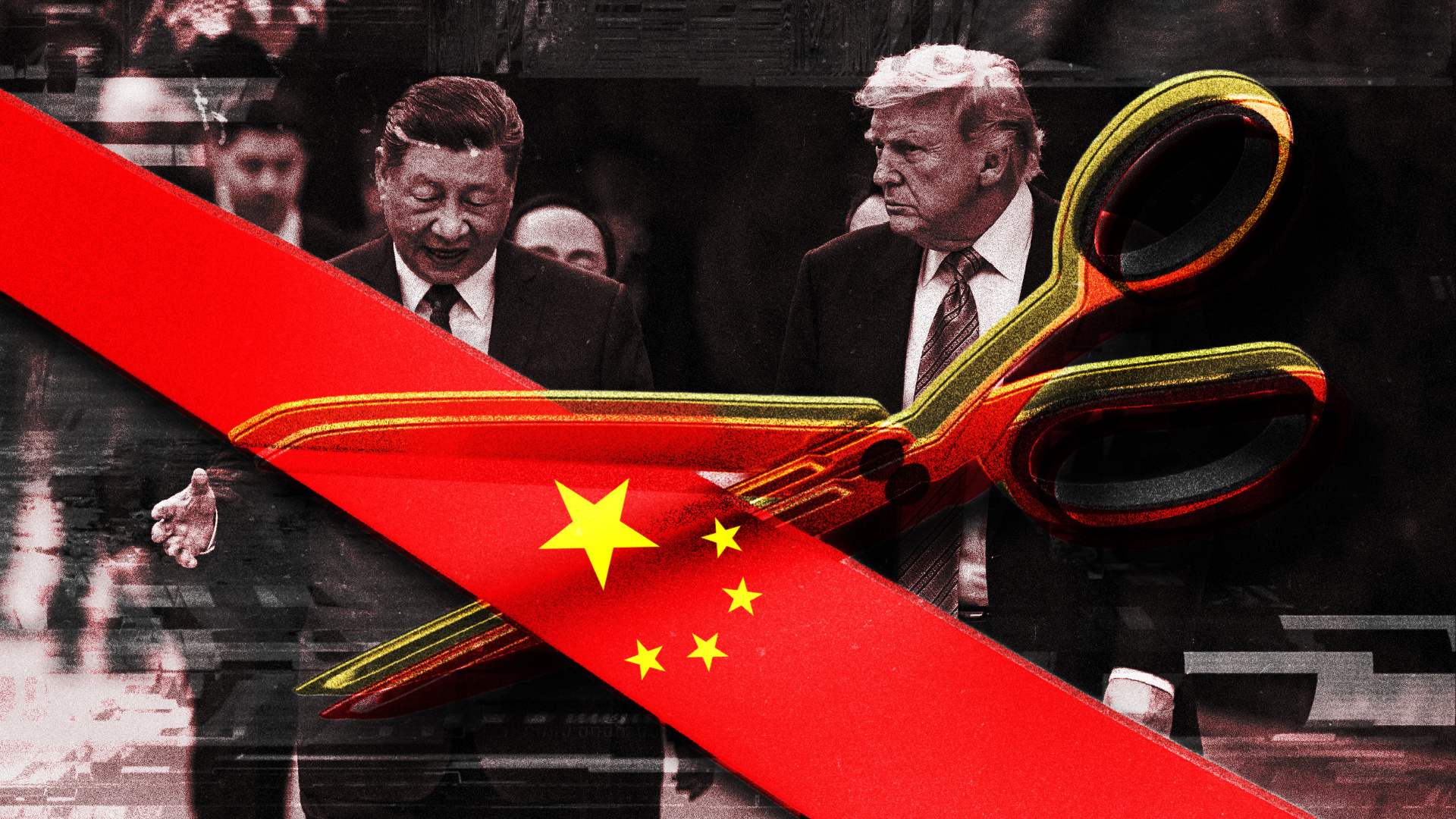
The report finds that China has consolidated global dominance in the midstream stages of battery supply chains—refining and chemical conversion—giving the Chinese Communist Party significant influence over pricing, supply availability, and industrial investment.
While critical minerals such as lead, antimony, lithium, nickel, cobalt, graphite, and manganese are mined across multiple regions, the report shows that refining capacity remains heavily concentrated in China, allowing the country to convert industrial advantages into geopolitical leverage through export restrictions, price manipulation, and supply shocks.
The report comes as policymakers in Washington intensify efforts to rebuild domestic critical mineral supply chains. Recent initiatives include Project Vault, a public-private effort supported by the Export-Import Bank to create a U.S. strategic critical minerals reserve and support domestic manufacturing investment.
“The United States is not resource-poor—it is processing-constrained,” said Mihir Torsekar, CPA senior economist and author of the report. “Even when minerals are mined globally, they often flow to China for refining before being sold back to Western manufacturers as battery-grade materials. That concentration creates a structural vulnerability that allows supply chains to be disrupted or manipulated at moments of geopolitical tension.”
A detailed case study in the report examines the U.S. lead-acid starter battery sector, which retains strong domestic manufacturing and recycling capabilities—including a 99 percent recycling rate for lead—yet remains exposed to a single critical chokepoint: antimony refining, where China controls the overwhelming majority of global processing capacity.
When China imposed export restrictions on antimony during 2024–2025, global supply fell sharply and prices surged almost 200%, demonstrating how a single processing dependency can disrupt transportation fleets, logistics systems, data centers, and defense-related infrastructure that rely on reliable battery systems for the United States and its allies.
The report concludes that midstream processing control—rather than mining alone—determines supply chain security, and that rebuilding domestic and allied refining capacity is essential to U.S. economic and national security.
“This report underscores a hard reality: the United States is not short on critical minerals, we are short on the ability to process them into the materials our economy and military depend on every day. If China chose to cross the Taiwan Strait, that distinction certainly matters,” said Major General Bill Crane (Ret.) and Rear Admiral Peter Brown (Ret.), the chair and vice chair of the RBC’s Critical Minerals Leadership Roundtable. “Nowhere is this more evident than in the starter batteries that underpin every tank, jeep, MRAP, howitzer and helicopter. The same batteries that support military operations also power the trucks that deliver food, the systems that keep hospitals running during outages, and the infrastructure that underpins daily life.”
The report outlines a four-pillar strategy to restore U.S. supply chain resilience:
- Anchor long-term demand and investment stability for refining and processing capacity
- Enforce ownership-based eligibility standards to prevent Chinese-controlled processing from benefiting from U.S. incentives
- Integrate recycling and allied processing networks as strategic feedstock
- Expand applied research and innovation for next-generation battery technologies
“Battery supply chains underpin everything from electric vehicles to military logistics and grid resilience,” Torsekar added. “If the United States does not rebuild control over the refining and processing stages of production, it will remain exposed to supply disruptions and strategic leverage from foreign competitors.”
The full report is available here: “Wartime Footing: How the United States Can Reverse China’s Dominance of Battery Minerals Processing.”
# # #
ABOUT THE COALITION FOR A PROSPEROUS AMERICA
CPA is the only national organization exclusively representing domestic producers across many sectors. We are a bipartisan coalition of manufacturers, farmers, ranchers, and labor organizations that make and grow things in the United States.
American jobs, strength, and well being are built and sustained by growing America’s productive capacity. We value quality employment, national security, and domestic self- sufficiency over cheap consumption.
ABOUT THE RESPONSIBLE BATTERY COALITION
The RBC is a coalition of companies, academics, and organizations committed to the responsible management of the batteries of today and tomorrow. Members include: Advance Auto Parts, AutoZone, Capital City Ventures, Clarios, ENTEK, FedEx, Honda, and O’Reilly Auto Parts. RBC was created in April 2017 to advance the responsible production, transport, sale, use, reuse, recycling, and resource recovery of transportation, industrial, and stationary batteries and other energy storage devices. For more information: https://www.responsiblebatterycoalition.org/