


Findings Indicate that Copper Products Remain Essential to U.S. Economy and National Security as Trump Administration Seeks to Protect and Enhance Industry
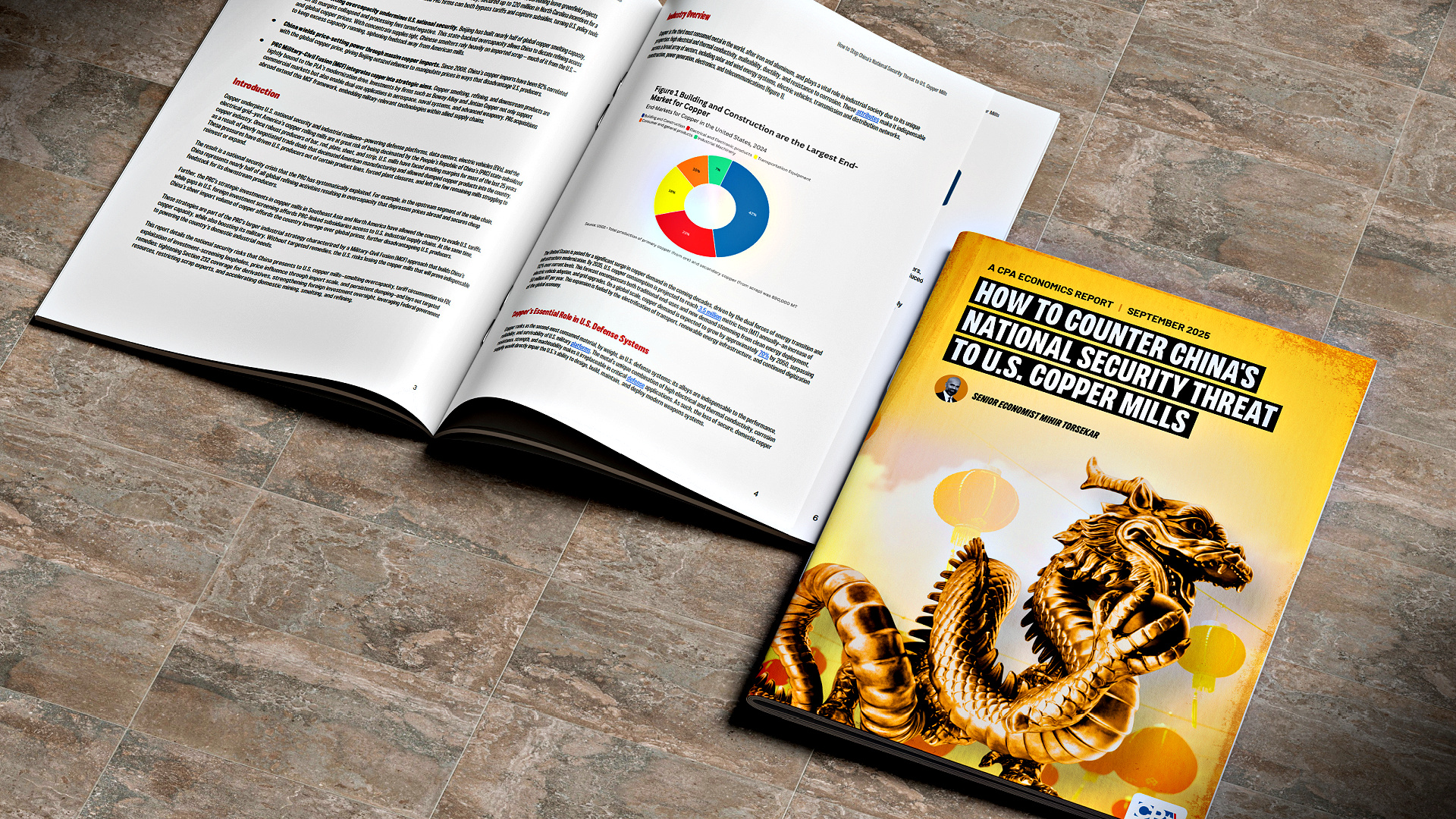
WASHINGTON, D.C. — The Coalition for a Prosperous America (CPA) today released a new report by its economics team titled, “How to Counter China’s National Security Threat to U.S. Copper Mills.” The report shows how the U.S. copper supply chain—vital to national defense, advanced manufacturing, and energy infrastructure—is under acute threat from the People’s Republic of China’s (PRC) state-directed copper industry.
The report’s findings show that at the same time PRC-linked firms have made strategic investments in Vietnam, Mexico, Germany, and even in the United States, including Wellascent’s $100 million flat wire plant in Texas and Boway’s subsidiary Boviet Solar, which secured up to $20 million in subsidies for a North Carolina facility – Beijing has simultaneously been building up massive, subsidized overcapacity in smelting and refining, now approaching half of all global output. This overcapacity allows China to manipulate prices, secure low-cost feedstock for downstream fabricators, and drive foreign competitors out of business.
On July 30, the Trump administration set Section 232 tariffs on semi-finished copper and copper derivative products. Prior to that, President Trump implemented a Section 232 investigation under the Trade Expansion Act into copper on February 25. This was a necessary step, but tariffs alone cannot address a structural overcapacity problem rooted in PRC subsidies, nor can they prevent Chinese firms already embedded in the U.S. from reaping windfalls.
For example, Wellascent’s new Texas facility will allow PRC-linked producers to avoid 232 tariffs entirely by producing inside U.S. borders, while Boviet Solar is collecting American subsidies to build out supply chains dominated by its Chinese parent Boway Alloy. Unless these gaps are closed, America risks ceding control of a material indispensable for defense, electrification, and the energy transition.
As CPA senior economist—and author of this report—Mihir Torsekar has argued, “Copper is not just another commodity—it is the backbone of America’s energy transition and defense supply chains. America’s copper industry doesn’t need a bailout. It needs smart policy and a fair fight.”
CPA strongly supported the decisive move by the administration to extend tariff protection against imports of semi-finished and copper-intensive products. The 232 action affirmed once more that the United States intends to reclaim economic independence for supply chains critical to our national and economic security.
CPA’s new report highlights that China exploits weaknesses in U.S. investment oversight – and because the Committee on Foreign Investment in the United States (CFIUS) rarely covers greenfield projects, Chinese state-backed firms have established strong footholds in North America – sometimes even drawing on U.S. taxpayer subsidies.
The report cites Jintian Copper’s Vietnam plant, which Commerce found was still dumping into the U.S. at an 8.35% margin in 2021, as an example of how PRC firms disguise country-of-origin to evade U.S. trade enforcement. Together with new U.S.-based plants, these moves show how tariff evasion, origin disguise, and dumping are all part of a single coordinated strategy. These moves, combined with Beijing’s dominant import demand, systematically erode U.S. competitiveness while advancing its Military-Civil Fusion (MCF) doctrine.
KEY POINTS
- PRC greenfield FDI in Texas and North Carolina exploits weak oversight and embeds Chinese firms directly in U.S. supply chains.
- Tariff-jumping through Vietnam and Mexico disguises origin and continues the dumping of under-priced copper into the U.S. market.
- American taxpayers are subsidizing PRC-linked companies while U.S. copper mills like Revere fight for survival.
- China’s smelting overcapacity undermines U.S. national security.
- China wields price-setting power through massive copper imports.
- PRC Military-Civil Fusion (MCF) integrates copper into strategic aims.
“This important new report from CPA’s industry-leading economics team highlights how U.S. trade policy has ignored for decades the erosion of the copper industry from our custom fabricators to our mid-level manufacturing capacity,” said Jon Toomey, President of the Coalition for a Prosperous America. “Copper underpins U.S. national security and industrial resilience, and the Trump administration’s action in July combining the Section 232 tariffs with the use of the Defense Production Act is a seismic change in how America protects its industrial supply chains.”
CPA’s report identifies the most urgent national security vulnerabilities in the copper supply chain and recommends targeted remedies, that if taken together, the measures will protect U.S. copper mills, counter predatory Chinese practices, and secure one of the most essential materials for America’s industrial and national security future. These include:
- Closing CFIUS loopholes to block PRC-linked greenfield investments;
- Placing repeat dumping offenders on the Commerce Department’s Entity List;
- Expanding tariffs to cover more copper-intensive derivatives;
- Designating copper as a U.S. Critical Mineral;
- Expanding incentives and leveraging the Defense Production Act (DPA) to spur domestic mining and production;
- Expanding Incentives for domestic copper production;
- Deploying advanced extraction technologies at scale;
- Strengthening U.S. Smelting and Refining Capacity;
- Updating Section 232 tariffs to add more copper derivatives;
- Enhancing coordination with U.S. Allies on the PRC copper threat;
- and, Restricting and closely monitoring scrap exports to China.
CPA and its members have long called for shoring up the U.S. copper industry – which is essential to national infrastructure, energy security, and defense readiness. In a July CPA economic analysis entitled ‘Copper Crisis: Why the U.S. Must Act Now to Save Its Copper Industry,’ Torsekar showed that the U.S. copper industry is at a crisis point, and the situation is placing U.S. copper fabricators in an impossible situation that demands immediate action. As Torsekar continues to argue, copper is indispensable to the future of American infrastructure, energy, and defense, making it vital for national security.
# # #