


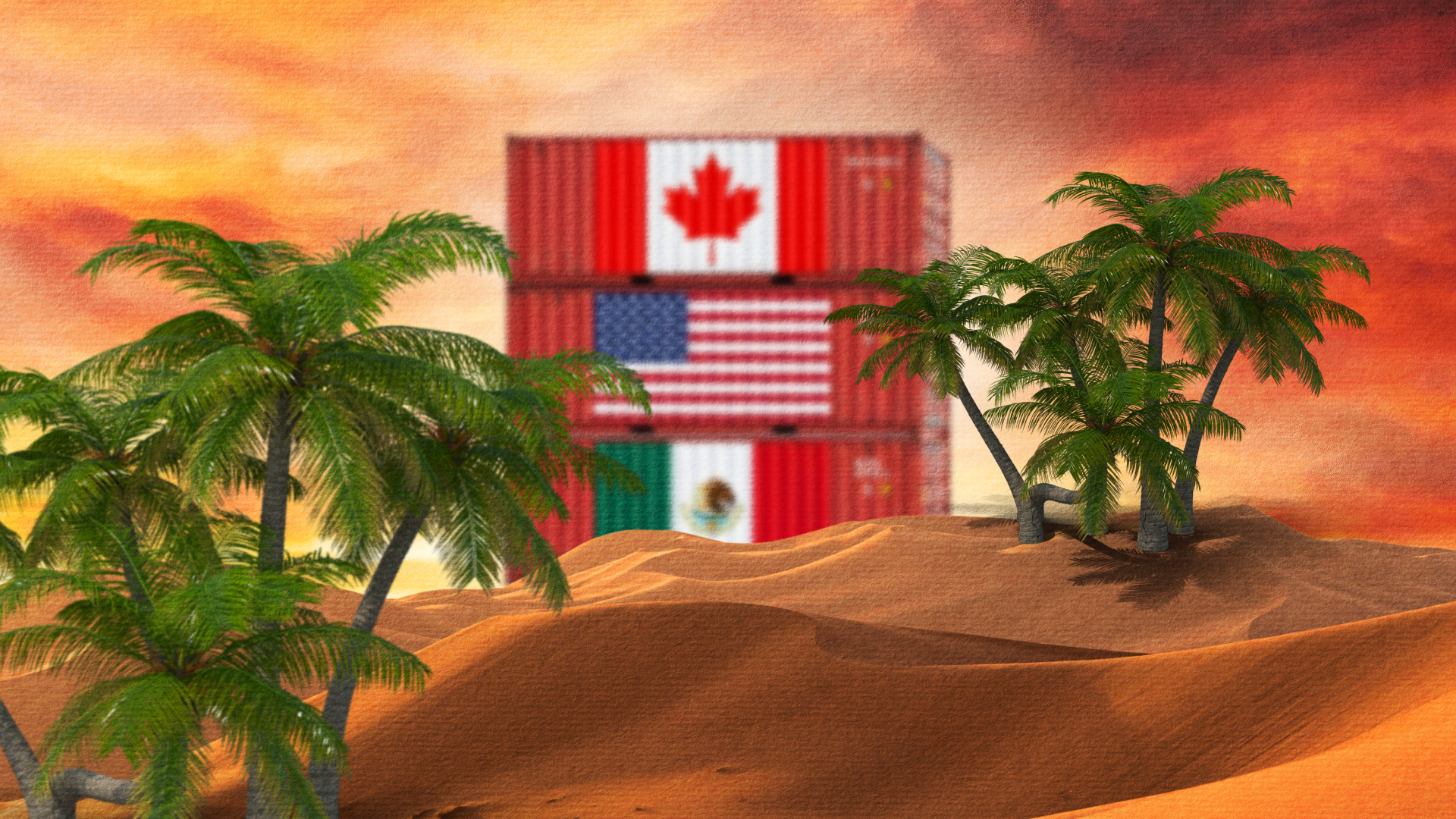
WASHINGTON, D.C. — The Coalition for a Prosperous America (CPA) today released a new analysis, “The ‘Fortress North America’ Mirage: Why Tariff Harmonization Will Never Work,” examining the collapse of the U.S.-Canada trade negotiations and the decade of evidence showing that a genuine North American tariff perimeter has never been on offer — and never will be. The piece documents how Canada and Mexico have pitched “Fortress North America” while refusing to withdraw any free trade commitments each country has made to over fifty others.
Ambassador Jamieson Greer said it plainly after the talks collapsed. “Fortress North America” was, he noted, “their term, not mine”. The United States has been willing to indulge the idea, asking for approximate efforts from Canada and Mexico to harmonize steel, aluminum and automotive tariffs. As Ambassador Greer said, Canada cannot remain “a place where you can get flooded with steel and aluminum from other countries and be used as a back door into the U.S.” And when the moment came, as Greer put it: “Fortress North America, you can say it, but when it gets down to brass tacks and you want to actually collectively protect this market and these critical sectors, they’re not gonna do it.” Prime Minister Carney — who months earlier declared a fortress in autos, steel, and aluminum to be “in everyone’s interest” — called the U.S. harmonization request “Unacceptable.”
CPA’s analysis documents that the fortress was always a mirage:
- Canada and Mexico won’t even veto China’s accession to the CP-TPP. Both remain founding drivers of a 12-nation global free trade bloc — 93.6 percent of tariff lines already duty-free, heading to 98.8 percent — that China is “steadily advancing” toward joining. Accession requires consensus, yet neither government has been willing to pronounce a one-word veto.
- Neither country will reopen a single FTA concession. Mexico has 14 free trade agreements covering 52 countries; Canada has 15 covering 52, with six more under negotiation. Both have refused to revisit their steel, aluminum, or automotive concessions in any of them — while the United States ended all of its Section 232 country exemptions.
- The 2019 steel and aluminum agreements failed catastrophically. Mexico promised to hold exports to historic levels and prevent transshipment. Instead, as CPA has documented, Mexican steel conduit imports ran 472 percent over baseline — reaching 87 percent of U.S. conduit imports — Chinese metal transshipped freely, and American mills were shuttered.
- Harmonized tariffs cannot harmonize prices. Steel, and especially aluminum, are more expensive in the United States than in either Canada or Mexico. This is proof positive that years and years of policy tweaks by the two countries on steel and aluminum have done nothing to bring about a North American market. So long as metal costs more in America, any U.S. tariff concession on downstream products will guarantee offshoring.
- The USMCA automotive rule of origin — the model for the next “fortress” pitch — was a bust. Mexico sends America 20 cars for every one it takes, the auto and parts deficit with Mexico peaked at $138.2 billion in 2024, and USTR’s own July report found Chinese content in Mexican auto exports rising while U.S. content declines.
- American production shrank while the fortress was being pitched. U.S. raw steel output fell from 87.8 million tons in 2019 to 82 million in 2025; primary aluminum production collapsed from 1.09 million metric tons to 660,000.
“In the actual real world, no ‘Fortress North America’ was ever on offer from Canada or Mexico,” said Jon Toomey, President of CPA. “Ambassador Greer just proved the point: the moment Canada was asked to take some token steps towards the fortress they championed, the Prime Minister’s answer was “Unacceptable.” There is a simple test for anyone still selling the fortress — ask whether Canada and Mexico will reopen their steel, aluminum, and auto concessions in TPP, which includes Chinese transshipment hubs like Malaysia and Vietnam, or even veto China’s accession to it. If the answer is no, the conversation is over. America’s tariffs protect the American home market. They are not for sale, and they are certainly not for harmonizing with countries that keep their back doors open to the world.”
The analysis also makes the deeper case: trading U.S. tariffs for “rules of origin” locks American mills, fabricators, and workers into unlimited price competition with lower-wage jurisdictions — a competition no rule can referee. Inside the United States, a federal policy floor on labor, environmental, and legal standards follows production wherever it moves. No such floor follows a factory across the Rio Grande or the St. Lawrence. Nor does a rule close a price gap: smelt-and-cast requirements imposed on Mexican aluminum in July 2024 failed to close the metal-price spread. That is why CPA has urged the administration to hold the line on the Section 232 metals tariffs, to reject USMCA aluminum exemptions, and to pursue outcome-based measures — tariffs and quotas — rather than academic “rules” that have already failed twice.
# # #