


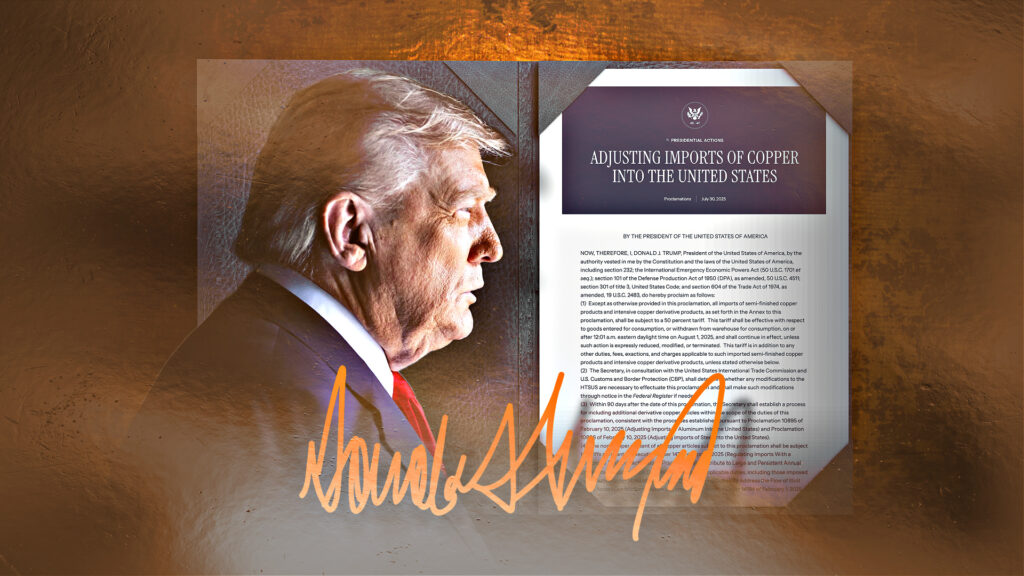
WASHINGTON, D.C. — The Coalition for a Prosperous America (CPA) strongly supports the Trump administration’s decisive move today to extend tariff protection against imports of semi-finished and copper-intensive products. This action, taken under Section 232 of the Trade Expansion Act, affirms again that the United States intends to reclaim economic independence for supply chains critical to our national and economic security.
“For decades, U.S. trade policy ignored the erosion of our custom fabricators, our mid-level manufacturing capacity,” said Jon Toomey, President of the Coalition for a Prosperous America. “Today’s action to directly target the midstream layer—rods, pipes, wires, connectors, and other semi-finished copper products that are essential to our economy and national security is extremely welcome. Combining the Section 232 action with the use of the Defense Production Act to ensure a robust supply of copper scrap for recycling is extraordinary. This is a seismic change in how America protects its industrial supply chains – a big win for fabricators who have largely been ignored until now.”
Unlike previous tariff actions that focused narrowly on raw materials or finished consumer goods, this decision goes to the heart of where U.S. industry has been most vulnerable. The United States imports the majority of its copper midstream inputs, leaving domestic manufacturers exposed to foreign manipulation, supply disruptions, and unfair competition—particularly from heavily subsidized producers in China and Southeast Asia.
“This is not just about copper,” Toomey added. “It’s about rebuilding the connective tissue of American industry—the mid-tier fabric that supports everything from electrical grids to defense platforms to semiconductors. Without a strong middle, the whole supply chain collapses. The Trump administration clearly gets that.”
The policy also smartly exempts upstream copper forms like ore, cathode, and scrap—ensuring U.S. smelters and recyclers can access critical raw materials while encouraging value-added manufacturing to return onshore.
President Trump ordered a Section 232 investigation into copper imports in February, using presidential authority on national security grounds to impose higher tariffs. Earlier this year, CPA applauded President Trump’s action to enforce Section 232 tariffs of 25% tariff on steel and aluminum. Later, Trump also used Section 232 to place 25% tariffs on most imported cars and car parts. Copper tariffs will mark the third time this year Trump has used Section 232 of the 1962 Trade Expansion Act to impose specific sectoral tariffs.
“We commend the President, Secretary Lutnick, and the Bureau of Industry and Security at the Department of Commerce for their continued dedication to ensure that America’s home market is protected and strengthened against predatory foreign competition, while simultaneously preserving critical jobs and revitalizing our domestic manufacturing base,” said Toomey.
In CPA’s economic analysis entitled ‘Copper Crisis: Why the U.S. Must Act Now to Save Its Copper Industry,’ CPA senior economist Mihir Torsekar makes clear that the U.S. copper industry — which is essential to national infrastructure, energy security, and defense readiness — is at a crisis point, and the situation is placing U.S. copper fabricators in an impossible situation that demands immediate action. As Torsekar argues, copper is indispensable to the future of American infrastructure, energy, and defense, making it vital for national security.
In April, CPA submitted comments regarding investigation of copper and copper articles, to the Office of Strategic Industries and Economic Security (SIES), Bureau of Industry and Security (BIS), at the U.S. Department of Commerce (DOC). CPA argued that ensuring robust and domestic supply and manufacturing capacity of copper and copper-containing articles is vital to national security – urging the Department to impose tariff-rate quotas, as well as a ban on scrap exports to safeguard critical infrastructure sectors.
# # #