


The Hollowing Out of America’s Medicine Cabinet

Two Case Studies in Lost Generic Manufacturing — and a Plan to Rebuild Domestic Capacity
EXECUTIVE SUMMARY
- America now imports most of the medicine it consumes. U.S. production now supplies just 27% of domestic pharmaceutical demand, down from 72% in 2002, while 2025 pharmaceutical imports reached a record $292 billion and the trade deficit reached roughly $165 billion. Since 2002, implied U.S. pharmaceutical consumption has risen by about $253 billion, but 99% of that growth has been met by foreign production. Meanwhile, U.S. pharmaceutical output grew from $124 billion to $234 billion, but roughly 99% of that increase went to exports, not America’s pharmacies and hospitals.
- The hollowing-out was driven by subsidized foreign overcapacity and a U.S. market that rewards the lowest bid. Chinese Active Pharmaceutical Ingredient (API) and Key Starting Material (KSM) capacity, Indian finished-dose manufacturing, U.S. buyer concentration, and chronic generic price deflation have pushed prices below the level needed to sustain reliable U.S. production. The result is visible in the shortage data: there are 223 active shortages as of March 31, 2026; the average active shortage lasts 5.3 years; drug product discontinuations rose 60% from 2024 to 2025; and 56% of drugs in shortage are priced below $1 per extended unit.
- Case study one: pediatric liquid medicines show both the danger and the opportunity. Imports of liquid-suspension ibuprofen and acetaminophen have doubled since early 2024. India supplied 82.7% of U.S. import volume from January 2025 through April 2026. Upstream, China supplied 99% of U.S. ibuprofen API imports and 68% of acetaminophen/paracetamol API imports. The 2022–23 fever-medicine crisis showed the cost of this fragility: hospitals resorted to crushing tablets into liquid by hand, and the FDA was forced to temporarily allow bulk compounding of ibuprofen suspension. But liquid orals have been one of the more dominant domestic production stories, with the majority of the market being supplied by US manufactures because their weight, bulk, and freight costs favor domestic production.
- Case study two: solid-dose tablets show how deeply offshore dependence now reaches into everyday medicine. The United States relies on imports for 78% of solid oral generics consumed in the U.S. India alone accounts for roughly 61% of total U.S. dispensed solid oral generic consumption and 68.5% of import volume across the key tablet lines examined. These are daily-use medicines for blood pressure, diabetes, seizures, arrhythmia, mental health, and muscle spasm, with amlodipine and hydrochlorothiazide alone running tens of millions of prescriptions a year. But many sell for pennies per tablet, leaving little margin for redundancy, quality investment, or domestic production. When these drugs go short and patients miss doses, the risk is immediate: blood pressure, blood sugar, seizure control, or heart rhythm can deteriorate quickly without stable daily treatment.
- The upstream chokepoint is even more concentrated than the finished-dose label suggests. A tablet may be finished in India, but many of the KSMs and APIs begin in China. China controls key starting materials behind major small-molecule medicines with oral-solid forms, including 94% of amoxicillin and 70% of acetaminophen. USP found that China was the sole supplier of at least one KSM for about 700 APIs, or 37% of the APIs in its analysis. Among drugs in shortage, 44% had at least one KSM made solely in a single country, typically China or India.
- The risk is not only shortages — it is quality and safety. FDA oversight remains weaker abroad than at home: in fiscal year 2023, roughly 90% of FDA foreign inspections were preannounced, while many foreign facilities have gone five years or more without inspection. The report documents Ranbaxy’s $500 million fraud settlement, Intas’s falsified records at a plant making 50% of U.S. cisplatin, Hetero’s unsanitary conditions, valsartan NDMA contamination, and Glenmark’s potassium chloride dissolution failures tied to more than 100 recalled batches and at least eight U.S. death reports. Outsourcing production also means outsourcing much of America’s ability to inspect, trace, and trust its medicine supply.
- The United States needs a comprehensive trade and industrial strategy to restore secure domestic medicine production. Targeted tariffs and TRQs should create market space; the PILLS Act and FDA domestic-manufacturing incentives should finance and accelerate new capacity; stronger import oversight should close the safety gap; and federal procurement should reward domestic supply defined down to the API and KSM level. The U.S. needs to rebuild enough domestic and trusted-allied capacity that essential medicines no longer depend on a single high-risk country, single foreign plant, or opaque upstream supply chain.
I. America Now Imports Most of Its Medicine
For the first time on record, the United States makes barely a quarter of the medicine it needs. The CPA Pharmaceutical Domestic Market Share Index — measuring the share of U.S. pharmaceutical demand met by U.S. production — has fallen from 72% in 2002 to just 27% as of 2025, computed from BLS sectoral-output indices and Census trade data [1] [2]. That is a 45-point collapse in a single generation, and the 2025 reading is the lowest on record. Imports reached a record $292 billion in 2025 — roughly seven times their 2002 value — leaving a pharmaceutical trade deficit of around $165 billion.
FIGURE 1
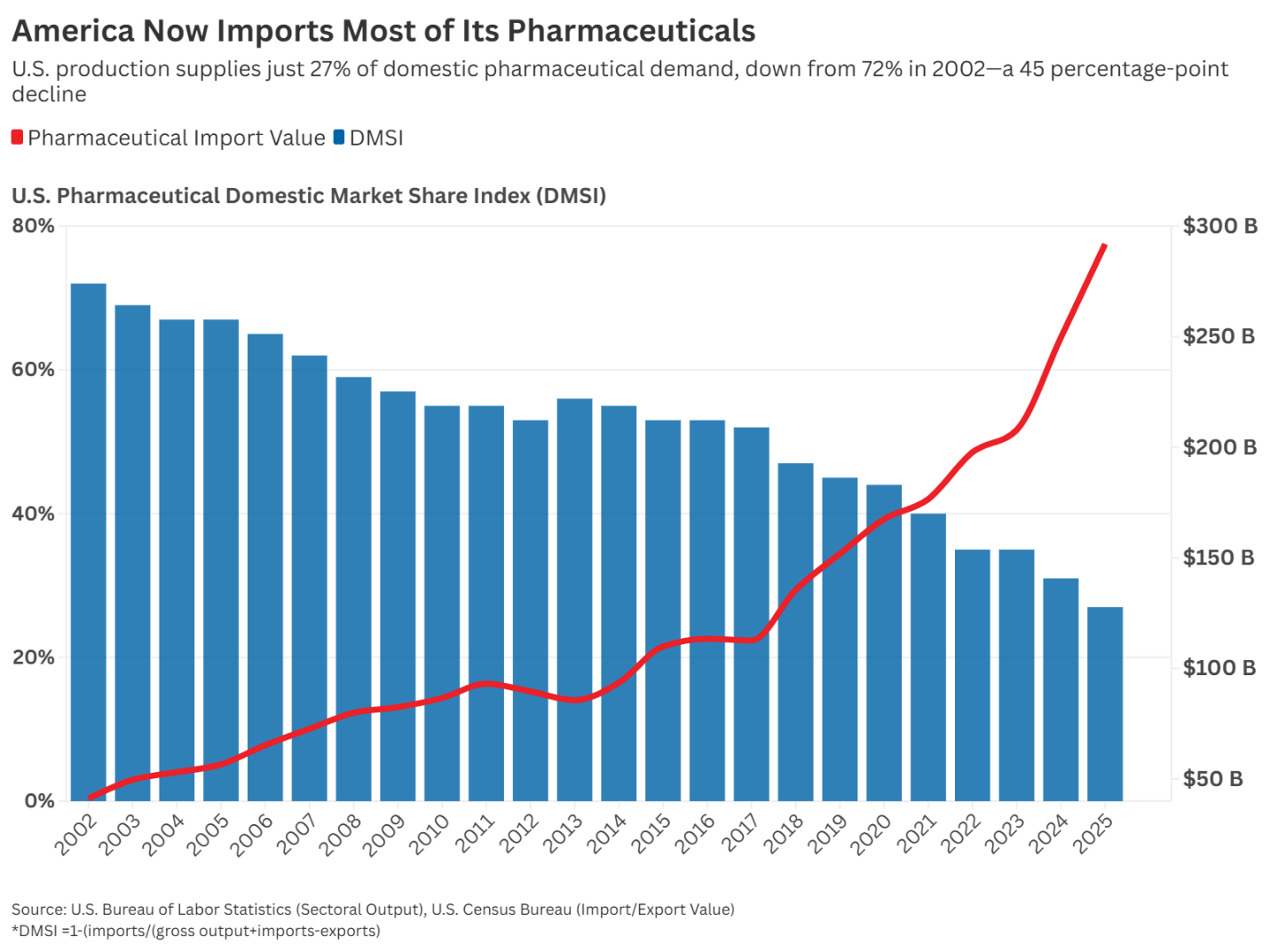
Figure 1 shows the two-decade structural slide that has never meaningfully reversed, and the underlying data sharpen the point. Start with consumption. Since 2002, implied U.S. pharmaceutical consumption — domestic output plus imports minus exports — has risen by roughly $253 billion. Imports rose by almost exactly the same amount. In other words, 99% of the growth in what America consumes has been met by foreign production, not domestic.
The supply side tells the mirror image: U.S. output did roughly double, from $124 billion in 2002 to $234 billion in 2025, but the entire increase was absorbed by rising exports, not serving America’s pharmacies or hospitals. Moreover, the majority of this rising pharmaceutical export value comes from high-value, specialized biologics and immunological products, not the high-volume commodity generics that hospitals and pharmacies rely on daily and that are most exposed to shortages [2]. Pharmaceutical production actually serving the domestic market — output minus exports — grew just 2% in twenty-three years. American production simply stopped growing for Americans, and foreign producers captured nearly all the U.S. market growth over the past two decades.
The FDA’s own supply-chain warnings show the same trend, and the picture is even more dangerous one layer upstream, in the active pharmaceutical ingredients (APIs) from which all medicine is built. Announcing a domestic generic-manufacturing pilot in 2025, the agency reported that just 9% of API manufacturers are located in the United States, against 22% in China and 44% in India [3]. The country is not merely importing more finished medicine; it has already lost much of the industrial base needed to make medicine in the first place.
Domestic output growth has not merely lagged import growth — it has been swamped by it. Every year, a larger share of the pills and bottles in American pharmacies is made somewhere else. This report examines what that decline looks like on the ground through two case studies: the liquid medicines parents give their children, and the critical solid-dose tablets that tens of millions of Americans take every day.
II. How It Happened: Subsidized Foreign Overcapacity
America did not lose its pharmaceutical industry in a fair fight. It lost ground to state subsidies, chronic overcapacity, and a global pricing structure that made reliable domestic production increasingly uneconomic. China has pursued a deliberate industrial strategy to make itself indispensable to the global drug supply chain: building cost advantages in upstream chemicals, subsidizing capacity, and undercutting competitors until domestic producers could no longer justify staying in the market. In the early 2000s, China flooded the global market with low-priced penicillin and vitamin C, helping drive U.S. producers out of the market as part of an industrial strategy backed by decades of state investment [4].
Brookings notes that Beijing has an explicit strategy to expand its global pharmaceutical position, with Chinese firms holding a strong cost advantage in upstream — and increasingly downstream — drug supply chains, reinforced by state tax breaks, subsidized loans, and infrastructure investment [5]. Those policies lower the price floor for generic medicine production. When the state absorbs part of the capital, financing, infrastructure, or operating cost, foreign producers can add capacity and sell at prices that U.S. plants cannot sustainably match.
India has pursued its own industrial-policy strategy, especially in finished-dose medicines, APIs, drug intermediates, and key starting materials. India’s Department of Pharmaceuticals lists production-linked incentive schemes for pharmaceuticals and for critical KSMs, drug intermediates, and APIs, along with a separate Bulk Drug Parks program that includes subsidized land, utilities, common infrastructure, and state fiscal incentives [6] [7].
The market effect from Chinese and Indian subsidies is visible across many products. For example, in June 2025, global ibuprofen prices fell sharply amid oversupply and intense production competition from China and India, with Chinese manufacturers having “acute overcapacity” and flooding the global market to clear inventory [8]. That is the hollowing-out mechanism: subsidy-backed capacity creates excess supply, excess supply pushes prices below the full cost of reliable U.S. production, and once domestic producers can no longer fund compliant facilities, redundant lines, and backup capacity, margin disappears — and eventually so does the plant.
III. Downstream, the Pressure Compounds into Shortages
Foreign subsidies and overcapacity push prices down from abroad; the U.S. purchasing system then locks that pressure into the domestic market. Generic medicines account for more than nine out of every ten U.S. prescriptions, but manufacturing them is a highly competitive, low-margin business [9]. Over the prior five years, U.S. patients consumed more generics by volume while the total value of generic sales fell by $6.4 billion [10] — meaning manufacturers had to supply more medicine for less revenue. The Association for Accessible Medicines warns that this high generic price deflation causes many companies to discontinue products, close facilities, or shut down altogether [9].
Buyer concentration amplifies the squeeze: three GPOs control roughly 90% of hospital generic contracting, while three major wholesaler/PBM-aligned buying alliances control about 90% of retail generic purchasing [9]. That leaves the hundreds of generic manufacturers competing for access to a small number of powerful buyers, often with as many as a dozen manufacturers, foreign and domestic, making the same product. In that structure, the lowest price wins — even when that price is too low to support redundant capacity, quality investment, or domestic production.
The shortage data show what that pricing model produces. There were 223 active shortages as of March 31, 2026, trending up for the second quarter in a row [11]. Shortages are also becoming more entrenched. The average active shortage now lasts 5.3 years, up from 4.3 years in 2024 and roughly two years in 2019 [12]. In addition, more than 64% of drugs currently in shortage have been unavailable for over three years, and 39% for more than five years [12]. The United States Pharmacopeia (USP) identifies the recurring drivers as low prices, manufacturing complexity, geographic concentration, and quality concerns [12] — exactly the vulnerabilities created when the market rewards minimum price over redundancy.
Discontinuation and shortage data show the exit pressure directly. Drug product discontinuations increased from 106 in 2024 to 170 in 2025, a 60% jump, and the products leaving the market were heavily concentrated at low prices: 65% of discontinued oral solids were priced below $1 per unit, with the median price dropping from $1.80 to $0.40 [12]. IQVIA’s shortage data show the same pattern from the patient side: shortages are concentrated in low-cost generics and injectables, with 56% of drugs in shortage priced below $1 per extended unit [13]. The medicines most likely to disappear are often the cheapest ones — the products with the least room to support quality upgrades, safety stock, or backup production.
The savings from these cheap imports disappear the moment shortages hit. Drug shortages drive up hospital error rates by 1–5%, create unsafe conditions in 60% of cases, and often force hospitals to pay 300–500% markups to obtain critical medicines [14]. That is the hollowing-out mechanism: subsidy-backed foreign capacity creates excess supply; concentrated U.S. buyers transmit that pressure through the generic market; and prices fall below what reliable domestic production can sustain. At that point, margins force companies to cut products, close lines, and eventually walk away from plants — leaving patients and hospitals to pay the real cost.
IV. Case Study One: The Liquid Medicines Children Depend On
Few liquid medicines are more universal than acetaminophen and ibuprofen — the fever-and-pain suspensions used in homes, pediatric wards, hospitals, and long-term care settings. A tablet may contain the same active ingredient, but it is not practically equivalent for a two-year-old with a fever or an elderly patient who cannot swallow. For these patients, dosage form is access: the medicine has to be measurable, swallowable, and available when needed. The burden of fragility falls hardest on those with the fewest substitutes; Vizient found that pediatric facilities monitor at least 25% more shortages than general hospitals [15].
That fragility has a cause. The domestic base for these medicines has thinned for years, squeezed by a market that rewards the lowest bid and punishes the redundancy that resilience requires. Generic liquid suspension production faces intense price competition, and the economics are unforgiving. USP found that low manufacturer prices materially increase shortage risk — a pressure that became visible in 2025, when product discontinuations jumped 60% to a five-year high as tight margins pushed manufacturers out of the market [12]. This pressure manifested for ibuprofen oral suspension in 2023 when Teva discontinued its 100 mg/5 mL prescription [16]. ASHP and the University of Utah cite this discontinuation as the direct cause of the resulting prescription-product shortage, as it left Indian-owned Taro as the sole prescription supplier in the retail market [16]. Each departure leaves less slack in the system — and a market with no slack has no way to absorb a shock.
That shock arrived just as the market was losing redundancy. In 2023, as RSV, flu, and COVID converged, demand for pediatric fever reducers spiked — and an already-thinned market had little reserve capacity. FDA stated that ibuprofen and acetaminophen oral suspension supplies had fallen short of demand, while hospitals and retailers struggled to obtain liquid ibuprofen for children and adults unable to swallow pills [17]. The shortage became visible at the bedside: Seattle Children’s Hospital reported that it had run out of liquid ibuprofen roughly two months earlier and had “moved completely away from the liquid preparations,” resorting instead to crushing tablets and mixing them into liquid by hand — a time- and resource-intensive workaround [18].
The FDA responded by temporarily allowing designated facilities to compound ibuprofen suspension in large batches for hospitals. But that workaround underscored the severity of the shortage: the compounded products were not FDA-approved, carried greater safety and efficacy risks, and could not be sold through retail pharmacies, where shortages were deepest [18]. When domestic capacity is thinned out, a crisis is inevitable and forces rationing, improvisation, and emergency workarounds.
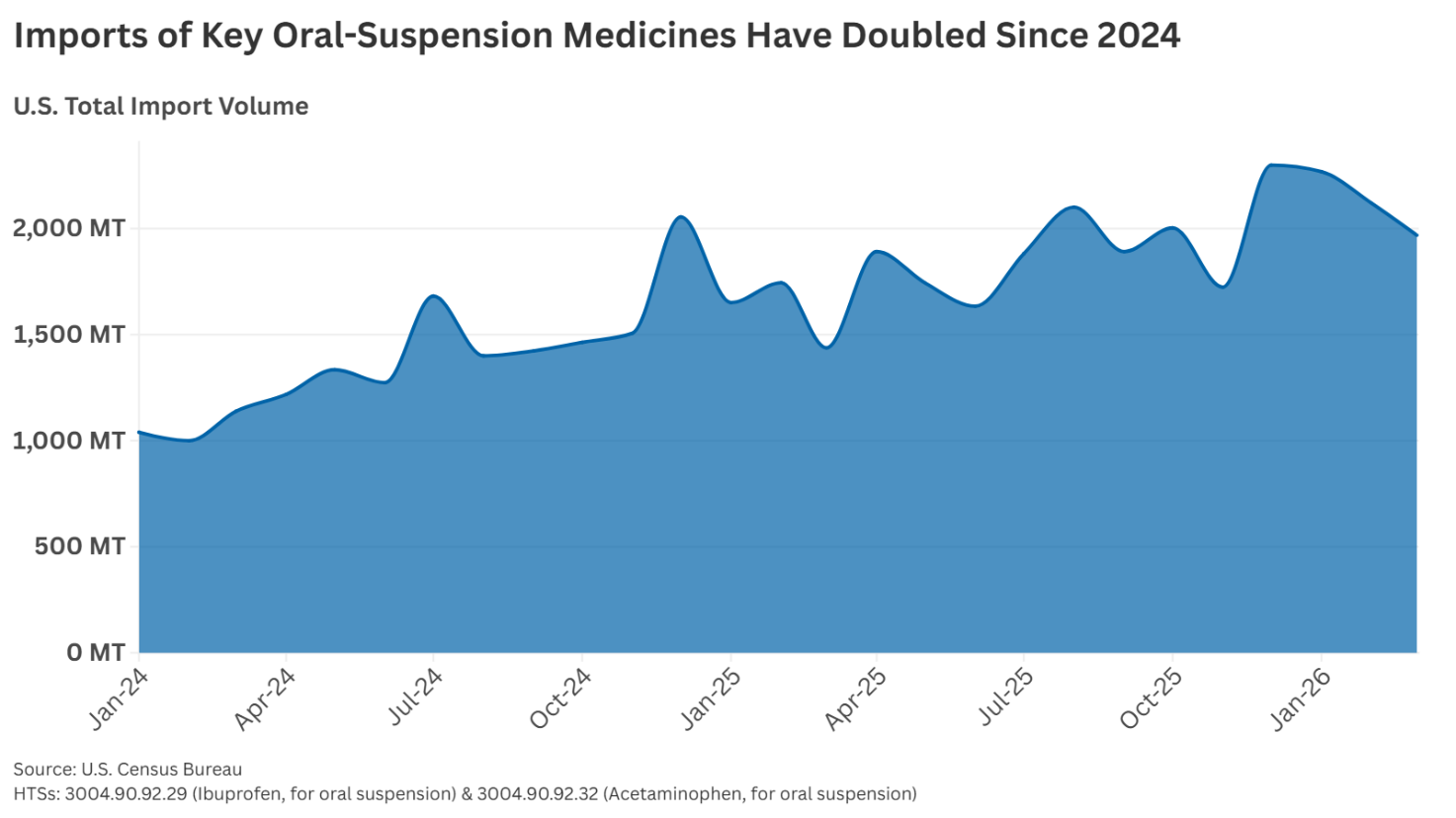
Meanwhile, the foreign dependence keeps deepening. As shown in Figure 2, U.S. imports of ibuprofen and acetaminophen oral suspensions have doubled since early 2024, from about 1,000 metric tons a month to peaks above 2,000 [2].
FIGURE 2
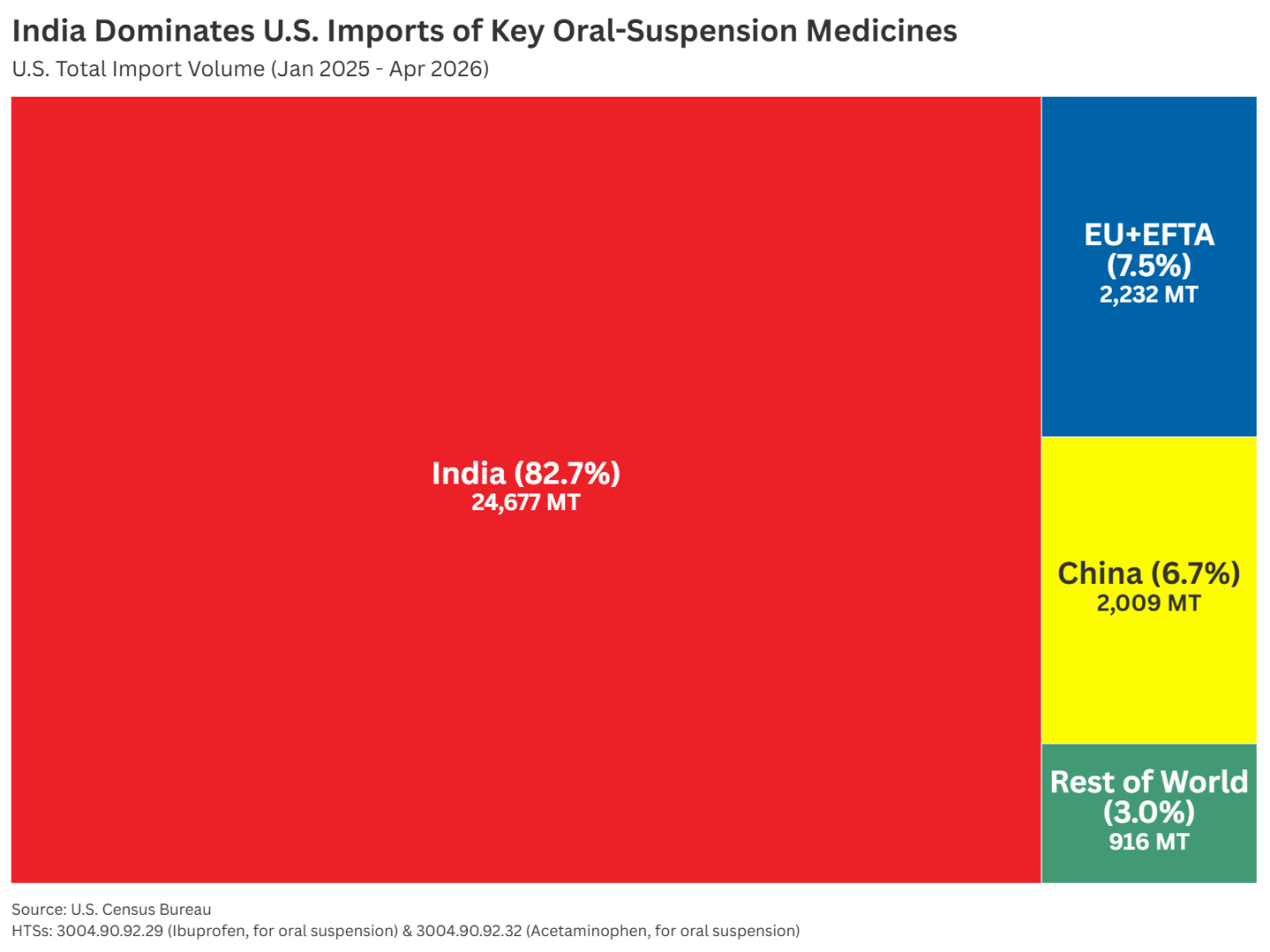
And the sourcing is dangerously concentrated. As shown in Figure 3, from January 2025 through April 2026, India supplied 82.7% of import volume, with China adding another 6.7% [2].
FIGURE 3
The concentration runs even deeper for upstream API, where China, instead of India, dominates. From January 2025 through April 2026, China supplied 99% of the U.S.’s ibuprofen API imports [2]. During the same period, China also supplied 68% of U.S. acetaminophen/paracetamol API imports, with India supplying an additional 29% [2].
The amoxicillin shortage shows that this is a global generic-market problem, not just an American one. Europe’s amoxicillin shortage reflected years of low prices, lowest-price tendering, rising production costs, and competition from lower-cost Asian suppliers, which left producers with little ability or incentive to add spare capacity [19]. The United States saw the same fragility in oral suspension: FDA declared a national shortage of amoxicillin liquid that stretched from October 2022 into 2025 and pushed prescribers toward broader-spectrum substitutes [20] [21]. Different markets, but the same failure mode: imports caused too much downward price pressure, leaving too little domestic production, too little margin, and no cushion when demand surged.
However, liquid orals are among the generic categories that has been a more domestic story because their economics already lean home. A liquid suspension is mostly water and packaging — heavy, bulky, temperature-sensitive in transit, and losing shelf life with every week at sea. These freight, storage, and shelf-life penalties significantly reduce the offshore cost advantage before any policy is enacted [22]. A U.S. liquid-manufacturing base still exists to build on, and with the right policy support, finished dosage production could rebound and reduce foreign dependance of liquid suspensions, preserving this domestic manufacturing base far faster than a from-scratch supply chain.
V. Case Study Two: Eleven Tablets America Lives On
Solid-dose tablets suffer the same market dynamics and price pressure as liquid suspensions and every other generic. These are the country’s daily maintenance medicines, and America has allowed their production to be offshored to an alarming degree. The same forces and foreign production pressure are at work: subsidized foreign overcapacity, a market that pays the lowest bid and nothing for resilience, and a domestic base that thinned one exit at a time until the country found itself dependent on factories an ocean away.
Consider eleven of these tablets: amlodipine and hydrochlorothiazide for high blood pressure; spironolactone for heart failure; glipizide for type 2 diabetes; sotalol for cardiac arrhythmia; primidone for seizures and essential tremor; trazodone, buspirone, and imipramine for depression, anxiety, and insomnia; and methocarbamol and carisoprodol for muscle spasm. These are high-volume staples, with amlodipine and hydrochlorothiazide alone running tens of millions of prescriptions a year [23].
The mechanism that hollowed out their production is well documented, even if the government has been slow to address the issue. FDA’s 2019 Drug Shortages Task Force examined 163 drugs that fell into shortage and concluded that shortages are primarily the consequence of economic factors, led by a lack of incentives to produce less profitable drugs — noting that many shortages began with the outright discontinuation of products for reasons like low drug price [24].
The price data show why. On CMS’s National Average Drug Acquisition Cost benchmark — the invoice price pharmacies actually pay — hydrochlorothiazide runs about a penny per tablet, amlodipine roughly a penny and a half, and buspirone about three cents [25]. These prices are continuing to be pushed down by import pressure. Year-over-year deflation on all generic oral-solid tablets is at 13.4% [26], with even more acute price pressure for discontinued oral-solid medicines, where the median price has dropped 78% in a single year [12]. At those declining prices there is no margin for redundancy and no investment case for increasing domestic production without a strong policy signal. In fact, these prices are the reason behind declining domestic production and product line discontinuation. USP found that two-thirds of discontinued oral-solid drugs were priced below $1 per unit [12].
Spironolactone illustrates the point. Par discontinued its tablet products in 2018 [27], and Pfizer later discontinued brand-name Aldactone in late 2025 as a business decision; in both cases, product exits contributed to meaningful supply disruptions [28]. Methocarbamol, a common muscle relaxant, shows the same fragility: shortages followed product discontinuations by Par and Virtus, then deepened when a remaining supplier faced an active-ingredient disruption [29]. Some manufacturers have made the strategy explicit. At its 2023 investor day, Teva said it would stop chasing the lowest-margin generics, backing away from low-cost products where intense price pressure had made the business unsustainable [30]. One by one, the companies that keep these tablets on American shelves are deciding that prices no longer justify the cost, complexity, and risk of staying in the market.
The clearest picture of what these decisions cost for a community sits in Morgantown, West Virginia. For decades, the Mylan — later Viatris — plant at Chestnut Ridge was one of the largest generic pharmaceutical factories in the country, operating since 1965 and providing well-paid manufacturing jobs in one of America’s lower-income states. In 2021, Viatris closed the plant as part of a global restructuring plan, eliminating roughly 1,500 to 2,000 jobs and sending work overseas, including to India [31]. Union officials estimated the closure would strip $150 million to $200 million in lost income from north-central West Virginia, and described the plant as one of the last major generic-manufacturing anchors in the United States [31]. Chestnut Ridge shows how production closures and offshoring create real economic consequences for communities across the country that extend beyond pharmacies and hospitals.
Morgantown is not an isolated story. In 2016 and 2017, Endo closed its Charlotte, North Carolina plant and its Huntsville, Alabama complex — 875 jobs at Huntsville alone — discontinuing more than 60 products and citing “greater than expected price erosion across the generics sector.” Amneal shuttered its Hayward, California facility in 2018, cutting roughly 550 jobs. Teva permanently exited its Irvine, California sterile injectables plant in 2022, laying off 305 workers. Akorn filed for Chapter 7 bankruptcy in February 2023 and closed every U.S. site — Decatur, Illinois; Somerset, New Jersey; Amityville, New York — terminating some 400 workers with no severance. Sandoz closed its Wilson, North Carolina tablet plant in 2024, eliminating 213 jobs after concluding the site could no longer produce at cost-effective volumes. And in June 2024, Jubilant Cadista closed its 1.5-billion-dose Salisbury, Maryland facility, stating that U.S. generic pricing pressure had made domestic manufacturing unprofitable — it now supplies the U.S. market from plants abroad.
The result of all these production closures amid suppressed and unsustainable margins is a thin and fragile generic supply base. Of 1,838 small-molecule drugs in 2022, 43% had only one manufacturer and another 16% had just two or three [32]. That means nearly 60% of small-molecule drugs had three or fewer manufacturers — a structure that has little room for a product line exit, quality hold, or demand shock.
That fragility matters because these are not optional medicines. They are daily maintenance drugs, taken indefinitely by patients whose health depends on uninterrupted supply. For example, a sotalol patient cannot simply restart after a gap; because the drug can itself trigger dangerous arrhythmias, FDA labeling requires at least three days of in-hospital cardiac monitoring when therapy is initiated or re-initiated [33]. A primidone interruption can mean breakthrough seizures [34], and a glipizide gap can destabilize blood sugar in a diabetic senior [35]. When a maintenance drug goes short, the problem is not a delayed treatment course — it is the disruption of ongoing therapy for millions of patients, often seniors on fixed incomes who are least able to chase scarce medicine across pharmacies or pay for additional medical care.
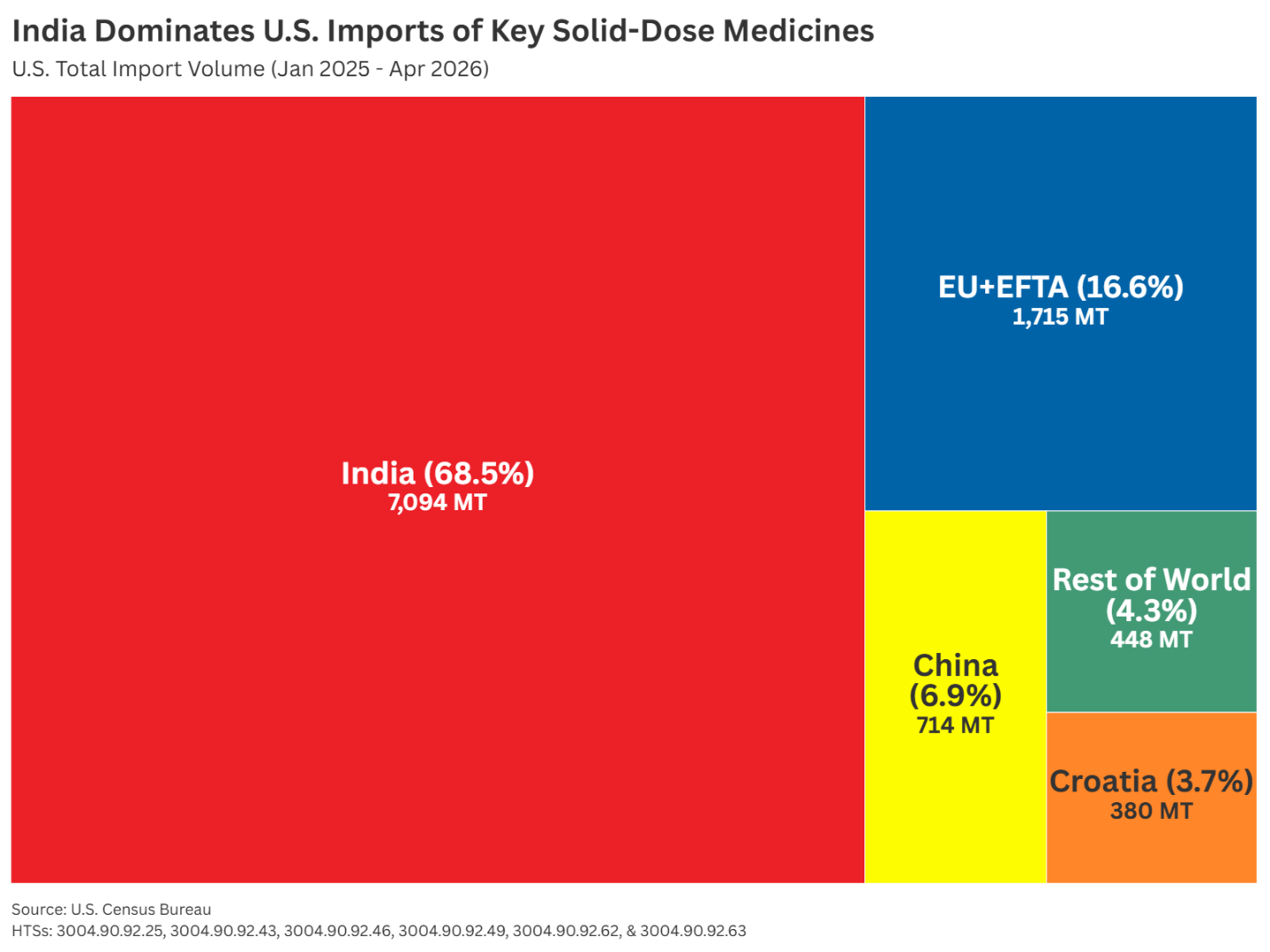
The same pattern leads back to imports. Price pressure, product discontinuations, and shortages are all intensified when low-cost foreign supply captures the market and domestic production thins out. The United States now relies on imports for 78% of its solid oral generics [36], and that dependence is highly concentrated. As Figure 4 shows, India supplied 68.5% of U.S. import volume across the tariff lines covering these key solid-dose tablet medicines from January 2025 through April 2026, compared with 16.6% from the EU and EFTA and 6.9% from China [2]. That leaves the United States dangerously reliant on a single country for a large share of its generic drug supply — a strategic risk made clearer during COVID, when India restricted exports of medicines and ingredients amid the crisis [37].
FIGURE 4
After decades of import growth, U.S. facilities now produce only about 22% of generic solid oral-dose medicine dispensed in American pharmacies, with part of that domestic share tied to controlled substances such as opioids and ADHD medicines that face stricter DEA-related production requirements [38]. India alone accounts for roughly 61% of all U.S. dispensed solid oral-dose generic volume [38]. The result is clear: for ordinary, high-volume tablets, the U.S. market is not merely importing more — it is structurally dependent on offshore production.
Solid-dose generics have the same hidden upstream chokepoint. A tablet may be finished in India, but every small-molecule medicine begins with key starting materials and APIs before it becomes a finished dosage form. That is where China’s role is most acute. China controls the key starting materials behind major small-molecule medicines with oral solid forms, including 94% of amoxicillin and 70% of acetaminophen [4]. USP found that China was the sole supplier of at least one key starting material for about 700 APIs, 37% of the APIs in its analysis [39]. This concentration is also directly linked to shortages. 44% of drugs in shortage had at least one key starting material made solely in a single country, typically China or India [40]. India dominates in finished-dose generics, but it is still dependent on Chinese intermediates and inputs, leaving a supply chain that remains heavily concentrated.
VI. The Quality We Cannot See: Safety Risks of a Foreign Drug Supply
The case for reshoring does not rest on shortages alone. When the United States offshored medicine production, it also offshored much of its ability to police quality and safety. Generics fill nine out of ten U.S. prescriptions [41], but more of those medicines now come from plants in India and China that the FDA sees less often, inspects with more notice, and cannot monitor with the same routine presence it has at home. By outsourcing production, we have also outsourced oversight — surrendering control over the integrity of the medicines our patients rely on.
The oversight gap is structural. Domestic drug plants can be inspected without warning; foreign plants, for most of the past two decades, have usually received advance notice. In fiscal year 2023, roughly 90% of FDA foreign inspections were preannounced, a sharp contrast with U.S. facilities, where inspections are typically unannounced [42]. This extra time before inspections gives foreign facilities time to clean lines, rehearse staff, stage records, and provide a very different picture from normal operating procedures. COVID widened the gap further, leaving many overseas facilities unvisited for five years or more [43]. FDA’s 2025 expansion of unannounced foreign inspections is a necessary correction [44], but still not proof the gap has closed; it only begins to bring overseas oversight closer to the U.S. standard.
Weak foreign oversight has allowed a persistent pattern of fraud and unsafe manufacturing conditions. Ranbaxy, once India’s largest generic maker, pleaded guilty in 2013 and paid $500 million to settle allegations that it fabricated test data and sold adulterated drugs [45]. A decade later, FDA inspectors at Intas Pharmaceuticals — which made 50% of America’s supply of the chemotherapy drug cisplatin — found a “cascade of failure” in quality control, including an analyst dissolving quality-control records in acid and torn testing documents hidden under a stairwell and in a truck outside the plant [46] [47]. In 2024, at a Hetero Labs facility, inspectors found birds in storage areas, lizards near raw ingredients, cats around pallets, damaged drums with torn labels, and a truck leaving uninspected after staff refused FDA access [48]. These are dangerous safety problems in a system where quality issues can be hidden until U.S. inspectors finally arrive, sometimes years later.
Those failures do reach patients. Beginning in 2018, tens of millions of blood-pressure pills were recalled after the probable carcinogen NDMA was found in valsartan ingredient made by China’s Zhejiang Huahai — contamination that FDA concluded may have circulated for years before detection [49]. The Glenmark case shows the danger. In 2024, FDA inspectors at the company’s India plant found repeated dissolution failures in potassium chloride capsules, along with poor cleaning and inadequate investigations [50]. It was the facility’s first FDA inspection in more than four years, dating back to before the COVID crisis [50]. Glenmark ultimately recalled more than 100 batches, while FDA adverse-event records included at least eight U.S. death reports associated with the product [50].
Even medicines that are never recalled can quietly underperform. A peer-reviewed 2025 study matching thousands of generics found that drugs made in India were associated with 54% more serious adverse events — hospitalizations, disabilities, and deaths — than the same drugs made in the United States, with the effect concentrated in mature, low-margin products where the incentive to cut corners is greatest [51]. Quality risk is therefore not separate from the economic story. When buyers reward the lowest price and production moves to distant plants under weaker routine oversight, the system creates pressure to minimize cost in ways that ultimately harm patients.
The contrast with domestic production is why reshoring matters. Domestic manufacturing does not guarantee perfection, but it makes accountability easier: FDA inspectors can arrive without warning, records and workers are under U.S. jurisdiction, and failures can be traced faster. A safe and reliable drug supply requires more than cheap finished doses at the border. It requires visibility, control, and enforceable standards from ingredient to finished dose. Reshoring is therefore the precondition for a medicine supply the country can inspect, trace, and trust.
VII. Key Policy Actions: A Comprehensive Reshoring Strategy
The United States needs a manufacturing strategy to reshore production of critical generic medicines. The goal is to rebuild enough domestic and trusted-allied capacity that essential medicines no longer depend on a single foreign country, a single foreign plant, or an opaque upstream supply chain. That requires four policies working together: protect the domestic market, finance new production, enforce high U.S. safety standards, and use federal purchasing power to reward resilience.
1. Protect the domestic market through targeted tariffs and TRQs. The first step is to stop exposing U.S. producers to unlimited subsidized imports in the very categories where domestic capacity has already been hollowed out. A pharmaceutical tariff-rate quota should target the real chokepoints: key starting materials, APIs, and finished-dose medicines from high-risk countries. Imports needed to meet current demand should be allowed to enter at low or zero tariff rates while U.S. capacity rebuilds, but those in-quota rates should be restricted to trusted countries with equivalent regulatory standards, as reflected in FDA Mutual Recognition Agreements. Above-quota imports and products from non-MRA or high-risk countries should face high specific duties by dose or kilogram, so foreign producers cannot keep pushing prices below the level needed for reliable U.S. production. Quotas should adjust annually as domestic capacity grows, with shortage waivers, reduced rates for firms with approved U.S. manufacturing plans, and strict origin documentation to prevent transshipment. The United States should import what it still needs — but on our terms, to our standards, and in a way that creates market space for domestic producers to return.
2. Jumpstart U.S. manufacturing with production and investment incentives. Tariffs create the opening; the PILLS Act fills it. Production and investment credits would make domestic generic manufacturing economically viable again after years of price compression. The credits would reward U.S. value-added, provide stronger support for API and finished-dose production, add a domestic-content bonus for U.S.-sourced materials, and exclude facilities with unresolved FDA warning letters. For solid-dose tablets, the credits offset the pennies-per-pill economics needed to quickly restart investment and production at home. For liquid orals, they accelerate a reshoring opportunity where weight, shelf life, and transport costs already favor U.S. production. Congress should also lock in FDA’s proposed domestic-manufacturing incentives, including a Paragraph IV timing advantage for U.S.-based generic manufacturers, support for advanced pharmaceutical manufacturing, stronger data-integrity enforcement, expanded inspection capacity, and improved API sourcing transparency. FDA review timelines should also favor reshoring rather than penalize it: prioritized ANDA review for U.S.-manufactured applications should be made permanent, and site-transfer supplements that move production to U.S. facilities should receive the same expedited treatment, so that a company willing to relocate a product home is not parked in the same queue as one moving it abroad. With a production tax credit, investment incentives, and FDA policies reoriented toward supply resilience, companies would finally have the foundation to expand capacity, hire American scientists, and secure a U.S. foothold in a sector we cannot afford to lose.
3. Overhaul FDA oversight of foreign production and imports. Even as domestic capacity rebuilds, the United States will still import medicines. Those imports must meet the same practical standard as domestic production. Foreign facilities should face unannounced inspections as the norm, with inspection frequency at the same level as U.S. facilities and enough FDA staffing to make that happen. Critical or high-risk imports should be subject to independent batch testing in certified U.S. labs for identity, potency, and impurities. Repeat violators should lose access to the U.S. market, and serious data falsification, contamination, or obstruction should trigger automatic import suspension, with longer bans for repeat offenses. FDA should also require full supply-chain transparency, including API country-of-origin and finished-dose site information. Moreover, generic user fees should reflect where oversight is hardest. The GDUFA foreign facility surcharge — $15,000, unchanged since 2012 and now roughly 6% of the domestic facility fee — should be raised substantially and indexed, with the added revenue dedicated to unannounced foreign inspection capacity, building on FDA’s 2026 proposal to waive domestic facility fees and increase the foreign differential to $25,000.
4. Realign government purchasing to reward resilience, not just the lowest bid. The U.S. purchasing system helped create this problem by rewarding the cheapest supplier while ignoring domestic capacity, redundancy, and quality history. Federal buyers — including the VA, DoD, Medicare, Medicaid, and the Strategic National Stockpile — should increase preferences for U.S.-made critical generics. “Domestic” should be defined down to the ingredient: U.S. finished-dose should earn a preference, but U.S. finished-dose made with U.S. or trusted-allied API and KSMs should earn an even stronger one. The government should use long-term anchor contracts and a Strategic API Reserve to sustain and grow baseline domestic production. GPO and PBM contracts should also be reformed to weigh FDA compliance history, supply redundancy, and domestic sourcing — not just the lowest quarterly price. If buyers keep rewarding only the lowest price at the cost of quality and reliability, domestic manufacturers will keep being forced out of the market.
Taken together, these pillars address the market failure documented in this report. TRQs create market space for domestic production. The PILLS Act finances capacity to increase quickly. FDA reform closes the safety double standard. Procurement reform gives domestic producers the stable demand needed to stay and grow in the market. The U.S. needs a drug supply where the next pandemic, export restriction, inspection failure, or demand surge does not leave American patients waiting on medicine from the other side of the world.
VIII. Conclusion: The Benchmarks and the Bottom Line
The collapse in the U.S. Pharmaceutical Domestic Market Share Index captures the severity in one stroke: a fall from 72% to 27% in a single generation. The consequences have been the children’s fever-medicine shortage, critical tablets whose domestic production has been ground away one plant closure at a time, and a growing reliance on a foreign supply base that the FDA cannot even adequately inspect. The common thread is structural: subsidized foreign overcapacity drove prices below the level at which American production could survive, the purchasing system rewarded that price and nothing else, and the domestic industrial base eroded over decades.
None of this is beyond repair, but drift does not reverse on its own. The four policy pillars outlined are the first steps needed to start rebuilding domestic capacity and stable supply. A country that cannot make its own medicine has surrendered a form of sovereignty as basic as the ability to feed or defend itself — and it has done so for a discount that evaporates the first time a pandemic, an export restriction, or a shuttered factory an ocean away leaves patients waiting. Rebuilding will take years and require long-term policy guidance, but the alternative is to keep gambling with American patients’ health on a daily basis. That is a mistake the country cannot afford to keep making.
REFERENCES
[1] Federal Reserve Bank of St. Louis, FRED. “Industrial Production: Manufacturing: Pharmaceutical and Medicine Manufacturing (NAICS 3254).” Federal Reserve Economic Data. https://fred.stlouisfed.org/series/IPUEN3254T300000000
[2] U.S. Census Bureau. “USA Trade Online.” https://usatrade.census.gov/
[3] U.S. Food and Drug Administration. “FDA Announces New ANDA Prioritization Pilot to Support U.S. Generic Drug Manufacturing and Testing.” FDA, 2025. https://www.fda.gov/drugs/drug-alerts-and-statements/fda-announces-new-anda-prioritization-pilot-support-us-generic-drug-manufacturing-and-testing
[4] Council on Foreign Relations. The Pharma Choke Point. CFR. https://www.cfr.org/reports/the-pharma-choke-point
[5] Brookings Institution. “What Policymakers Need to Know About China’s Role in the U.S. Drug Supply Chains — and What to Do About It.” Brookings. https://www.brookings.edu/articles/what-policymakers-need-to-know-about-chinas-role-in-the-us-drug-supply-chains-and-what-to-do-about-it/
[6] Government of India, Department of Pharmaceuticals. “Schemes.” Ministry of Chemicals and Fertilizers. https://www.pharma-dept.gov.in/schemes
[7] Government of India, Press Information Bureau. “Press Release on Pharmaceutical Industry Promotion Schemes.” PIB, 2025. https://www.pib.gov.in/PressReleasePage.aspx?PRID=2227631&lang=1®=3
[8] ChemAnalyst. “Global Ibuprofen Prices Tumble in June 2025 Amid Supply Glut, Weak Demand.” ChemAnalyst, 2025. https://www.chemanalyst.com/NewsAndDeals/NewsDetails/global-ibuprofen-prices-tumble-in-june-2025-amid-supply-glut-weak-demand-37956
[9] Association for Accessible Medicines. Drug Shortages: AAM White Paper. AAM, June 2023. https://accessiblemeds.org/wp-content/uploads/2024/11/AAM_White_Paper_on_Drug_Shortages-06-22-2023.pdf
[10] IQVIA Institute for Human Data Science. The Use of Medicines in the U.S. 2023. IQVIA, 2023. https://www.iqvia.com/-/media/iqvia/pdfs/institute-reports/the-use-of-medicines-in-the-us-2023/the-use-of-medicines-in-the-us-2023.pdf
[11] American Society of Health-System Pharmacists. “Drug Shortages Statistics.” ASHP. https://www.ashp.org/drug-shortages/shortage-resources/drug-shortages-statistics
[12] United States Pharmacopeia. Annual Drug Shortage Report. USP. https://www.usp.org/supply-chain/drug-shortages/annual-drug-shortage-report
[13] IQVIA Institute for Human Data Science. Drug Shortages in the U.S. 2023. IQVIA, 2023. https://www.iqvia.com/insights/the-iqvia-institute/reports-and-publications/reports/drug-shortages-in-the-us-2023
[14] McLaughlin, M., et al. “Effects on Patient Care Caused by Drug Shortages: A Survey.” Journal of Managed Care & Specialty Pharmacy, 2013. https://pmc.ncbi.nlm.nih.gov/articles/PMC4589883/
[15] Vizient. “New Vizient Survey Finds Drug Shortages Cost Hospitals Nearly $900M Annually in Labor Expenses.” Vizient, 2025. https://www.vizientinc.com/newsroom/news-releases/2025/new-vizient-survey-finds-drug-shortages-cost-hospitals-nearly-900m-annually-in-labor-expenses
[16] American Society of Health-System Pharmacists. “Ibuprofen Oral Suspension Shortage.” ASHP Drug Shortages. https://www.ashp.org/drug-shortages/current-shortages/drug-shortage-detail.aspx?id=889&loginreturnUrl=SSOCheckOnly
[17] U.S. Food and Drug Administration. “Questions and Answers on Compounded Oral Suspension Medications for Pain and Fever.” FDA. https://www.fda.gov/drugs/human-drug-compounding/questions-and-answers-compounded-oral-suspension-medications-pain-and-fever
[18] New Scientist. “U.S. Hospitals Are Facing Critically Low Supplies of Liquid Ibuprofen.” New Scientist, 2023. https://www.newscientist.com/article/2356728-us-hospitals-are-facing-critically-low-supplies-of-liquid-ibuprofen/
[19] Reuters. “Why Europe’s Drug Shortages May Get Worse.” Reuters, February 8, 2023. https://www.reuters.com/business/healthcare-pharmaceuticals/why-europes-drug-shortages-may-get-worse-2023-02-08/
[20] U.S. Food and Drug Administration. “Compounding Certain Beta-Lactam Products in Shortage Under Section 503A of the Federal Food, Drug, and Cosmetic Act.” FDA. https://www.fda.gov/regulatory-information/search-fda-guidance-documents/compounding-certain-beta-lactam-products-shortage-under-section-503a-federal-food-drug-and-cosmetic
[21] Fierce Pharma. “After Adderall, Common Antibiotic Amoxicillin Runs Into Shortage Amid Demand Spikes.” Fierce Pharma. https://www.fiercepharma.com/manufacturing/after-adderall-common-antibiotic-amoxicillin-runs-shortage-amid-demand-spikes-and
[22] Brookings Institution. “When Cheap Becomes Fragile: How the Race to the Bottom in Generics Undermines Manufacturing Quality and What to Do About It.” Brookings. https://www.brookings.edu/articles/when-cheap-becomes-fragile-how-the-race-to-the-bottom-in-generics-undermines-manufacturing-quality-and-what-to-do-about-it/
[23] ClinCalc. “DrugStats Database.” ClinCalc. https://clincalc.com/DrugStats/
[24] U.S. Food and Drug Administration. Drug Shortages: Root Causes and Potential Solutions. FDA, 2019. https://www.fda.gov/drugs/drug-shortages/report-drug-shortages-root-causes-and-potential-solutions
[25] NDCList. “National Average Drug Acquisition Cost: NDC 29300-128-10.” NDCList. https://ndclist.com/ndc/29300-128/package/29300-128-10/price
[26] 46brooklyn Research. “Drug Price Changes Hit the Deep February Freeze.” 46brooklyn. https://www.46brooklyn.com/news/drug-price-changes-hit-the-deep-february-freeze-jd48ht
[27] American Society of Health-System Pharmacists. “Spironolactone Tablets Shortage.” ASHP Drug Shortages. https://www.ashp.org/drug-shortages/current-shortages/drug-shortage-detail.aspx?id=447
[28] Becker’s Hospital Review. “8 Drugs in Shortage.” Becker’s Hospital Review. https://www.beckershospitalreview.com/pharmacy/8-drugs-in-shortage-2/
[29] American Society of Health-System Pharmacists. “Methocarbamol Tablets Shortage.” ASHP Drug Shortages. https://www.ashp.org/drug-shortages/current-shortages/drug-shortage-detail.aspx?id=423
[30] Fierce Pharma. “Amid Nationwide Shortages, Teva to Edit Its Generics Strategy and Slash Loss-Making Products.” Fierce Pharma. https://www.fiercepharma.com/manufacturing/amidst-nationwide-shortages-teva-edit-its-generics-strategy-slash-loss-making
[31] The Guardian. “West Virginia Viatris Plant Jobs Move Overseas.” The Guardian, June 20, 2021. https://www.theguardian.com/business/2021/jun/20/west-virginia-viatris-plant-jobs-overseas
[32] National Academies of Sciences, Engineering, and Medicine. Building Resilience into the Nation’s Medical Product Supply Chains. National Academies Press. https://www.ncbi.nlm.nih.gov/books/NBK603242/pdf/Bookshelf_NBK603242.pdf
[33] American College of Cardiology. Sotalol Considerations for Use. ACC. https://www.acc.org/~/media/Non-Clinical/Files-PDFs-Excel-MS-Word-etc/Tools%20and%20Practice%20Support/Quality%20and%20Clinical%20Toolkits/AFib%20Toolkit/Sotalol.pdf?la=en
[34] DailyMed. “Primidone Medication Guide.” National Library of Medicine. https://dailymed.nlm.nih.gov/dailymed/medguide.cfm?setid=a90d5ba6-4170-0b97-5ae3-fc707c9e4f1b
[35] DailyMed. “Glipizide Label.” National Library of Medicine. https://dailymed.nlm.nih.gov/dailymed/fda/fdaDrugXsl.cfm?setid=4a2d814b-93a1-4487-b789-dbafe9f0ffd3&type=display
[36] Center for the Business of Health, University of North Carolina. “Pharmaceutical Tariffs and MFN Policy: Analyzing Impacts on Pricing and Supply Chains.” UNC CBOH. https://cboh.unc.edu/publication/pharmaceutical-tariffs-and-mfn-policy-analyzing-impacts-on-pricing-and-supply-chains/
[37] The Guardian. “India Limits Medicine Exports Over Coronavirus Fears.” The Guardian, March 4, 2020. https://www.theguardian.com/world/2020/mar/04/india-limits-medicine-exports-coronavirus-paracetamol-antibiotics
[38] Brookings Institution. “Pharmaceutical Tariffs: How They Play Out.” Brookings. https://www.brookings.edu/articles/pharmaceutical-tariffs-how-they-play-out/
[39] United States Pharmacopeia. “Concentrated Origins, Widespread Risk: New USP Insights on Key Starting Materials.” USP Quality Matters. https://qualitymatters.usp.org/concentrated-origins-widespread-risk-new-usp-insights-key-starting-materials
[40] United States Pharmacopeia. “USP 2026 Annual Drug Shortages Report: Rising Discontinuations and Supply Chain Risk.” USP, 2026. https://www.usp.org/news/usp-2026-annual-drug-shortages-report-rising-discontinuations-supply-chain-risk
[41] U.S. Food and Drug Administration. “Generic Drugs.” FDA. https://www.fda.gov/drugs/buying-using-medicine-safely/generic-drugs
[42] White & Case. “FDA Foreign Inspections: Key Developments and Strategic Shifts.” White & Case. https://www.whitecase.com/insight-alert/fda-foreign-inspections-key-developments-and-strategic-shifts
[43] U.S. Government Accountability Office. Drug Safety: FDA Should Fully Assess Its Foreign Inspection Program and Staffing Needs. GAO-24-107359. https://www.gao.gov/products/gao-24-107359
[44] U.S. Food and Drug Administration. “FDA Announces Expanded Use of Unannounced Inspections at Foreign Manufacturing Facilities.” FDA, 2025. https://www.fda.gov/news-events/press-announcements/fda-announces-expanded-use-unannounced-inspections-foreign-manufacturing-facilities
[45] U.S. Department of Justice. “Generic Drug Manufacturer Ranbaxy Pleads Guilty and Agrees to Pay $500 Million to Resolve False Claims Allegations, GMP Violations, and False Statements to FDA.” DOJ, 2013. https://www.justice.gov/archives/opa/pr/generic-drug-manufacturer-ranbaxy-pleads-guilty-and-agrees-pay-500-million-resolve-false
[46] The Washington Post. “Cancer Drug Shortage Reveals Fragile U.S. Supply of Generics.” The Washington Post, June 27, 2023. https://www.washingtonpost.com/business/2023/06/27/cancer-drug-shortage-generics/
[47] U.S. Food and Drug Administration. Form FDA 483: Intas Pharmaceuticals Limited. FDA, 2022. https://www.fda.gov/media/164602/download
[48] Fierce Pharma. “Finding Birds, Lizards and Cats, FDA Says ‘Oh My’ to Hetero in Scathing Form 483.” Fierce Pharma. https://www.fiercepharma.com/manufacturing/finding-birds-lizards-and-cats-fda-says-oh-my-hetero-scathing-form-483
[49] U.S. National Library of Medicine / National Institutes of Health. “Valsartan, N-Nitrosodimethylamine, and Cancer Risk.” PubMed Central. https://pmc.ncbi.nlm.nih.gov/articles/PMC6351967/
[50] ProPublica. “Glenmark Pharmaceuticals Recalls and FDA Inspection.” ProPublica. https://www.propublica.org/article/glenmark-pharmaceuticals-recalls-fda-inspection
[51] Kelley School of Business, Indiana University. “All Generic Drugs Are Not Equal: Study Finds Generics Made in India Have More Severe Adverse Events.” Kelley School of Business Blog, February 19, 2025. https://blog.kelley.iu.edu/2025/02/19/all-generic-drugs-are-not-equal-study-finds-generics-made-in-india-have-more-severe-adverse-events/