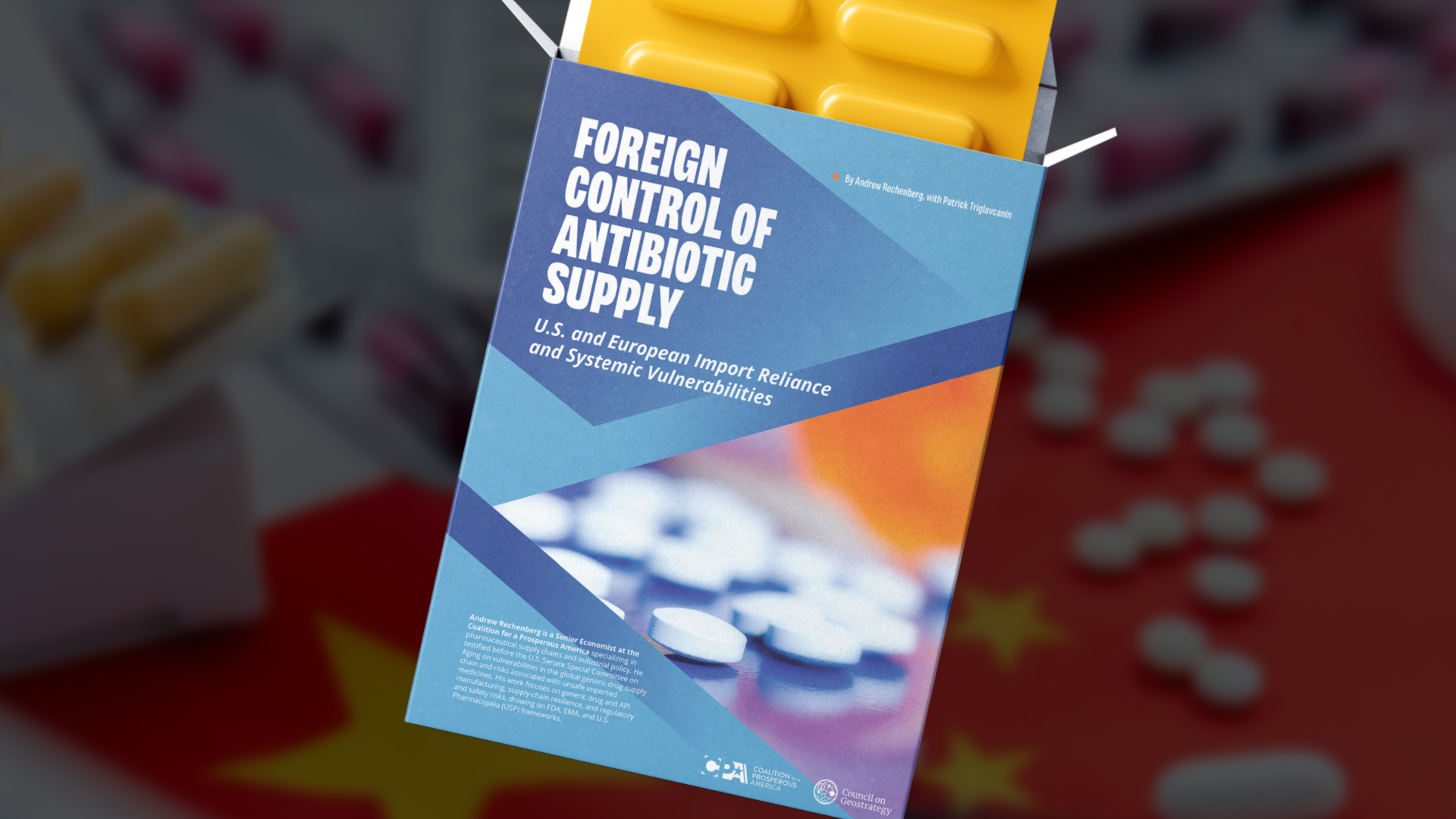



WASHINGTON, D.C. — The Coalition for a Prosperous America (CPA), in collaboration with the Council on Geostrategy, today released a new report detailing the United States’ dangerous reliance on foreign-controlled antibiotic supply chains and the urgent need to protect and rebuild domestic and allied manufacturing capacity across both upstream and downstream production.
The report, titled “Foreign Control of Antibiotic Supply: U.S. and European Import Reliance and Systemic Vulnerabilities,” finds that the United States is overwhelmingly dependent on China for the active pharmaceutical ingredients (APIs) that form the foundation of modern antibiotics, with China supplying approximately 87% of U.S. antibiotic API imports. This upstream dependence creates a single point of failure for the U.S. healthcare system and national security.
“America cannot remain dependent on unsafe foreign suppliers or supply chains controlled by strategic adversaries for the basic medicines hospitals use every day,” said Andrew Rechenberg, co-author of the report and Senior Economist at the Coalition for a Prosperous America. “Without secure upstream API and 6-APA production, the United States does not have true antibiotic supply security. With the right policy framework and close coordination with European partners, we can rebuild domestic capacity, strengthen allied production, and secure essential medicines for the long term.”
Key Findings
- China dominates the upstream supply chain: China supplies approximately 87% of U.S. antibiotic API imports and 80–90% of global API production.
- A single chokepoint structure: The global system operates through a China APIs → India finished drugs → United States and Europe import pipeline, leaving little redundancy.
- Extreme concentration risk: Only a handful of firms and facilities control production of key antibiotic inputs, creating systemic vulnerability and single points of failure.
- Critical upstream gap in the U.S.: The United States has no domestic penicillin API or 6-APA production capacity, making cooperation with Europe essential to secure allied upstream antibiotic supply chains.
“Antibiotics are not just another pharmaceutical product—they are essential infrastructure for modern medicine and national security,” said Jon Toomey, President of the Coalition for a Prosperous America. “The United States still maintains a foothold in finished-dose manufacturing through companies like USAntibiotics, but without upstream API production and vertically integrated capacity, we do not have true supply chain security. That leaves the entire system exposed to foreign disruptions and geopolitical risk.”
U.S. Manufacturing Reality
The United States retains a limited but important foothold in antibiotic manufacturing. USAntibiotics continues to produce finished-dose amoxicillin domestically, serving as a critical downstream capability. However, the United States lacks upstream antibiotic API production or vertically integrated penicillin manufacturing.
This stands in stark contrast to Europe’s Sandoz Kundl facility in Austria—the last remaining large-scale, fully integrated penicillin production site in the Western world. The report calls for transatlantic cooperation with allied, high-quality producers like Kundl to expand secure upstream antibiotic production in Europe and the United States and reduce dangerous dependence on Chinese APIs and intermediates.
China’s Control of Antibiotics Exposes Western Militaries and Hospitals
The report shows that the global antibiotic supply chain operates through a highly concentrated two-country system: China produces APIs, India formulates finished drugs, and the United States and Europe import the result. This structure creates multiple layers of vulnerability, leaving U.S. hospitals, patients, and military readiness dependent on a small number of foreign producers and facilities.
The report also highlights how decades of price suppression driven by subsidized Chinese production have eroded U.S. and European manufacturing capacity. Today, China accounts for an estimated 80–90% of global antibiotic API production and controls approximately 90% of the world’s 6-APA capacity—the critical intermediate for penicillin-class drugs.
CPA emphasized that rebuilding domestic antibiotic production requires a coordinated policy response that addresses both upstream and downstream vulnerabilities. This includes deploying targeted trade tools to counter persistent price suppression, reforming procurement policies that prioritize supply security over lowest-cost sourcing, and investing in fermentation and synthesis capacity in the United States and allied countries.
The report calls for closer coordination with European partners to preserve and expand remaining production assets, particularly the Sandoz Kundl facility, and to develop a resilient transatlantic manufacturing base capable of supporting both civilian healthcare and military readiness.
Read the full report: “Foreign Control of Antibiotic Supply: U.S. and European Import Reliance and Systemic Vulnerabilities”
# # #